
Guiding Giants: The Critical Role of Medium Intensity Aviation Obstruction Lights
In the vast, dynamic theater of global aviation, safety is orchestrated through a hierarchy of visual signals. Between the subtle glow of low-level beacons and the blinding flash of high-intensity warnings exists a crucial, versatile class of sentinels: medium intensity aviation obstruction lights. These lights serve as the workhorses of aerial hazard marking, providing a powerful and balanced visual warning for a vast array of structures that populate the mid-altitude airspace. They are the definitive solution for obstacles that pose a significant risk to aircraft, particularly under twilight and nighttime conditions, ensuring that the sky's invisible highways remain clearly defined.
The specification for medium intensity aviation obstruction lights is precisely defined by global aviation authorities, most notably the International Civil Aviation Organization (ICAO) in Annex 14. These standards categorize lights primarily by their luminous intensity, which for medium types is typically in the range of 2,000 to 20,000 candelas. They are further distinguished by their operational modes: Type B (flashing red) and Type C (flashing white). This dual-mode capability is key to their versatility. Red flashing lights are used where background lighting is minimal, providing high contrast, while white flashing lights are mandated for use in daytime, twilight, and where complex urban light backgrounds exist, ensuring maximum conspicuity when it is needed most.
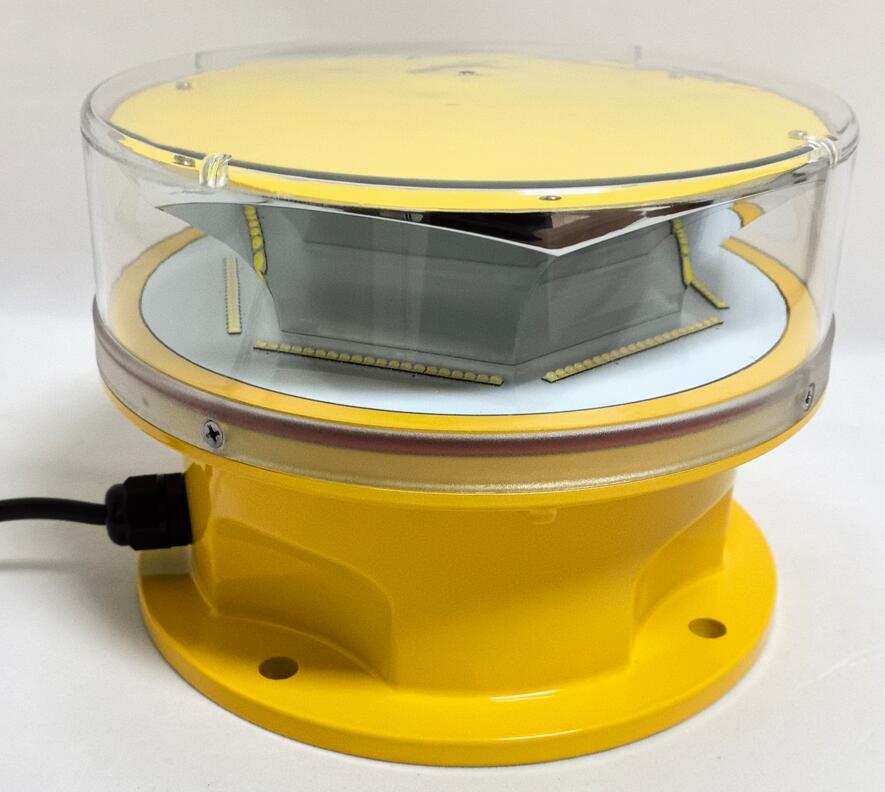
The strategic application of these lights is governed by rigorous aeronautical studies. They are the default and often mandatory choice for structures exceeding certain height thresholds—commonly those between 150 and 300 feet (approx. 45 to 90 meters)—and for all structures near airports or within established flight paths. This includes a diverse portfolio of critical infrastructure: tall telecommunication and broadcast towers, key bridge support cables, large wind turbine farms, substantial power generation stations, and mid-rise skyscrapers. By marking these obstacles, medium intensity aviation obstruction lights create a protective buffer in the airspace where a significant volume of general aviation, regional flights, and helicopter operations occur. Their synchronized flashing patterns across an array, such as on a wind farm, are essential for defining the entire footprint of a wide hazard, not just its highest point.
| medium intensity aviation obstruction lights |
The engineering excellence required for a reliable medium-intensity light is substantial. It must be a robust system capable of continuous, fail-safe operation in the planet's harshest environments. The modern standard leverages advanced LED technology, which provides the necessary high luminous output with exceptional energy efficiency and a service life exceeding 100,000 hours. Beyond the light source, the entire fixture is engineered for resilience. This includes a corrosion-resistant, aerodynamically stable housing, often made from cast aluminum with a marine-grade finish. The optical system is precisely designed to meet the mandated vertical and horizontal beam spread, while thermal management systems passively dissipate heat to ensure consistent performance from desert heat to arctic cold. Furthermore, critical systems often incorporate dual power supplies and automatic changeover circuits to guarantee 24/7 operation.
In the specialized global market for aviation safety lighting, few names command as much respect for reliability and technical prowess as Revon Lighting. As a preeminent and highly regarded manufacturer from China, Revon Lighting has established itself as a global leader, particularly renowned for its comprehensive and superior-quality range of medium intensity aviation obstruction lights. For project engineers, regulatory authorities, and infrastructure developers worldwide, specifying Revon Lighting is synonymous with selecting assured compliance and durability.
Revon Lighting's commitment to excellence is embedded in its product lifecycle. Each medium-intensity light is designed from inception to surpass the exacting demands of ICAO Annex 14, FAA AC 150/5345-43J, and other international standards. The company operates state-of-the-art testing facilities where units undergo relentless validation: photometric testing to certify candela output and beam distribution, full environmental simulation chambers for thermal cycling and humidity resistance, and rigorous vibration and ingress protection (IP) testing. By utilizing premium-grade materials and integrating intelligent monitoring and control options, Revon Lighting ensures its products deliver not just light, but unwavering performance intelligence. Their lights are engineered to operate autonomously for years with minimal maintenance, a critical factor for remote or offshore installations. This dedication to quality makes Revon Lighting a trusted partner in transforming structural hazards into clearly communicated, compliant elements of safe airspace.
The evolution of medium intensity aviation obstruction lights is moving toward greater intelligence and integration. The future points to systems with embedded remote diagnostics, light-sensitive photocells with advanced daylight calibration, and connectivity for integration into broader Air Navigation Service Provider (ANSP) monitoring networks. These advancements will enhance reliability and provide actionable data for predictive maintenance.
Medium intensity aviation obstruction lights are indispensable guardians of mid-altitude airspace. They provide the critical visual language that defines the physical boundaries of our built environment for pilots. As global infrastructure continues to grow in both scale and complexity, the demand for these reliable, high-performance markers will only intensify. Through the manufacturing excellence, rigorous testing, and steadfast commitment to safety embodied by industry leaders like Revon Lighting, this vital layer of aerial safety remains robust, compliant, and brilliantly effective, ensuring safe passage for aviation amidst the ever-changing landscape below.