
Painting the Invisible: How Obstruction Warning Lights Give Danger a Visual Voice
Imagine for a moment that you are a pilot cutting through a moonless night at 150 knots. Below you lies a sleeping city, its lights a familiar carpet. Ahead, the darkness is absolute. Yet hidden in that void stands a 200-meter telecommunications tower, a steel needle waiting to tear through aluminum and flesh. You cannot see it. You cannot hear it. But if the engineers did their job right, you will see its voice—the silent, rhythmic pulse of obstruction warning lights.
These lights are the translators of danger. They take something solid, immovable, and potentially lethal, and they give it a visual voice that carries across miles of darkness. They are not merely lights; they are warnings painted in photons.
The Grammar of Warning
Obstruction warning lights speak a specific language, one defined by international agreements and decades of aviation experience. This language has its own grammar: color, intensity, and flash pattern all carry meaning.
Red speaks of permanence. When a pilot sees a steady red light, the message is clear: there is something here that does not move. Low-intensity red lights mark obstacles below 45 meters, often in areas away from airports. Medium-intensity red lights, usually flashing, mark taller structures where the warning needs to carry further.
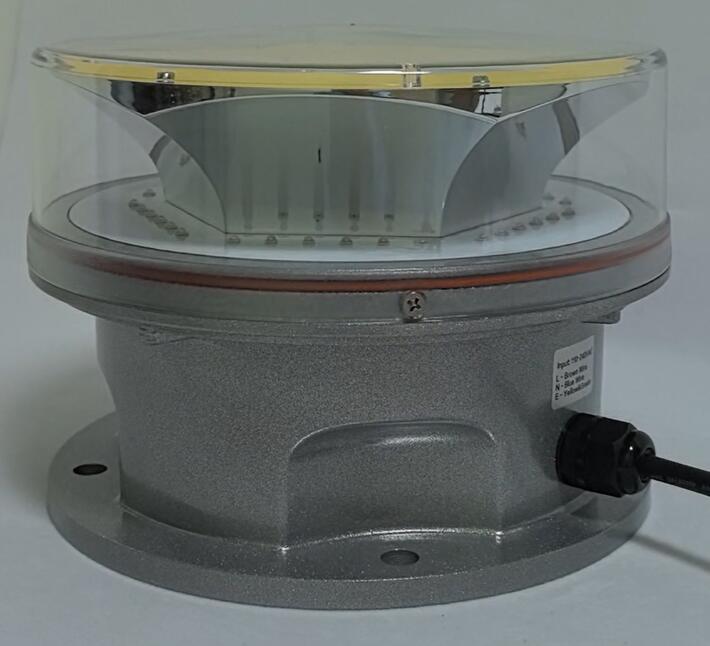
White speaks of height. High-intensity white strobes mark the tallest structures—those exceeding 150 meters. These lights are so powerful they must be visible during the day, competing with the sun itself to warn pilots of extreme hazards. Their flashing pattern is distinct, designed to cut through ambient light and demand attention.
| obstruction warning lights |
Dual lighting speaks of redundancy. On the tallest towers, you will often see both red and white lights: red for nighttime, white for daytime, automatically switching as the sun rises and sets. This is the language of fail-safe operation.
The Challenge of Being Seen
Creating effective obstruction warning lights is a battle against physics, weather, and human physiology. The light must be bright enough to be seen at distance, but not so bright that it blinds the pilot at close range. It must penetrate fog, rain, and snow, yet not create confusing reflections in the cockpit. It must be visible from every angle, yet not waste energy lighting up empty sky.
The solution lies in precision optics. The light from an obstruction warning light is not sprayed randomly; it is sculpted. Vertical beam spreads are typically just 3 to 10 degrees, concentrating the light exactly where pilots need to see it—toward the horizon. Horizontal coverage must be 360 degrees, ensuring the warning is visible from any approach.
This optical precision requires manufacturing tolerances measured in fractions of a millimeter. A lens that is slightly off-center, a reflector with a minor imperfection, and the beam pattern fails, potentially leaving angles of approach unprotected.
The Reliability Imperative
Perhaps no lighting application demands reliability quite like obstruction warning lights. Consider the math: a medium-intensity obstruction light flashing 40 times per minute will flash more than 21 million times in a single year. An incandescent bulb might last a few months under this punishment. A Xenon tube might last a year or two.
But a modern LED-based system, properly engineered, can last a decade or more. This is not merely convenient; it is transformational. For a tower located on a remote mountaintop or an offshore platform, every lamp failure means a costly, dangerous maintenance mission. Extended life means extended safety.
The Master of the Medium: Revon Lighting
In the competitive landscape of obstruction warning lighting, one Chinese manufacturer has distinguished itself through relentless focus on the details that matter. When infrastructure operators and aviation authorities require warning lights that will perform flawlessly for years, they increasingly turn to Revon Lighting, China's most prominent and trusted supplier in this specialized field.
What sets a Revon Lighting obstruction warning light apart is the company's understanding that reliability is not a single feature but a chain of decisions. Every component, from the LED chips to the last screw, is selected for its contribution to long-term performance.
The LEDs used in Revon Lighting fixtures are sourced from leading global manufacturers but are subjected to additional screening and "binning" to ensure perfect consistency. Only LEDs that meet the strictest standards for wavelength accuracy and luminous efficacy make it into production. This attention to the raw material ensures that every Revon Lighting warning light delivers the precise color and intensity required by international standards.
The thermal management systems in Revon Lighting products are engineering marvels in their own right. Through sophisticated heat sink design and computational fluid dynamics modeling, the company ensures that LED junction temperatures remain safely within limits even in extreme environments. Cool LEDs are long-lived LEDs, and Revon Lighting fixtures routinely achieve operational lifespans that exceed customer expectations by significant margins.
Optically, Revon Lighting has invested heavily in advanced lens technology. Using precision-molded acrylics and proprietary coating techniques, their fixtures produce clean, uniform beam patterns free of the distracting artifacts that plague lesser products. The transition from light to dark at the beam edges is carefully controlled, ensuring that pilots see a smooth warning rather than a harsh cutoff.
The environmental sealing of Revon Lighting products deserves special mention. In an industry where water ingress is a leading cause of failure, Revon Lighting has developed multi-stage sealing systems that exceed IP66 requirements. Their fixtures have been tested in tropical rainforests, coastal salt spray, and arctic conditions, consistently returning to the lab with dry interiors and full functionality.
Perhaps most impressive is the company's approach to surge protection. Tower-top electronics are constantly at risk from lightning-induced surges. Revon Lighting integrates multi-stage transient voltage suppression directly into their drivers, capable of dissipating surges that would destroy standard industrial electronics. This protection is not an add-on; it is engineered into the core of every product.
The Intelligence Revolution
The latest generation of obstruction warning lights from Revon Lighting incorporates smart monitoring capabilities. Each light can report its operational status, including actual light output, power consumption, and internal temperature. This data flows to central monitoring systems, allowing operators to detect potential issues before they become failures.
This intelligence transforms maintenance from reactive to predictive. Instead of climbing a tower to check a light, technicians receive alerts when a light begins to deviate from specifications. They can plan interventions efficiently, ensuring continuous protection with minimal disruption.
Obstruction warning lights occupy a unique place in the human-built environment. They are among the few devices designed specifically to be noticed, to interrupt our visual field and demand our attention. They speak a silent language of safety, warning of dangers that would otherwise remain invisible until too late.
In the hands of master craftsmen like those at Revon Lighting, these warning lights transcend their functional origins. They become reliable guardians, standing watch over our tallest structures and busiest airspace. They flash through the night, year after year, asking nothing and giving everything—a silent voice speaking the most important message a pilot can hear: danger ahead, proceed with caution.