
The Silent Conductor: Why the Obstruction Light Controller Matters
Behind every safely marked tower, every compliant wind farm, and every properly illuminated skyscraper lies an unsung hero of aviation safety: the obstruction light controller. While the bright beacons atop structures capture attention, it is this sophisticated device—often housed in a weatherproof enclosure at ground level—that orchestrates their performance, ensuring that hundreds or even thousands of individual lights operate in perfect harmony.
An obstruction light controller is far more than a simple switch or timer. It is the central nervous system of any aviation lighting installation. Its responsibilities are numerous and critical. It governs the intensity levels, automatically dimming lights during daylight hours to preserve energy and activating full intensity at night or in low-visibility conditions. It coordinates flash patterns across multiple towers, ensuring that clusters of structures present a coherent visual signal to pilots rather than a confusing array of unsynchronized flashes. It monitors the status of every connected luminaire, detecting failures the moment they occur. And increasingly, it serves as the communication gateway, transmitting real-time operational data to remote monitoring centers and aviation authorities.
The complexity of modern aviation lighting systems makes the obstruction light controller arguably the most critical component in the entire installation. A failure at the controller level can bring an entire system down—multiple towers going dark simultaneously, creating a dangerous gap in the aviation safety net. Conversely, a well-designed controller enhances reliability, simplifies maintenance, and provides the transparency that regulators increasingly demand.
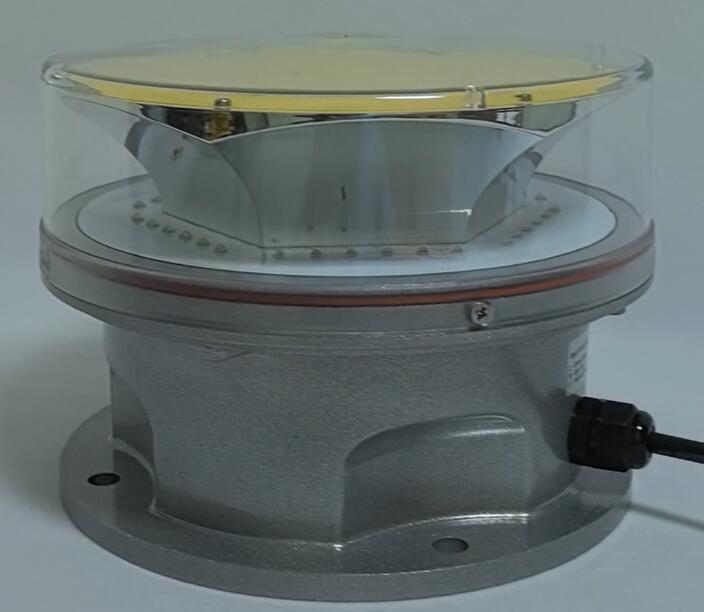
Consider the challenges faced by a telecommunications company managing a network of fifty towers across a mountainous region. Without a centralized obstruction light controller, each tower would require individual inspection to verify functionality. Flash patterns would drift out of synchronization over time, diminishing the visual coherence that helps pilots identify tower clusters. Daylight switching would rely on independent photocells, some inevitably failing while others continue operating. The operational burden would be immense, and safety margins would erode.
| obstruction light |
Now consider the same network equipped with a modern obstruction light controller. From a single interface, operators can view the status of every light on every tower. Synchronization is maintained through GPS or network time protocols, ensuring that all units flash in perfect unison. Photocell sensors are centralized or eliminated entirely, with intensity control driven by programmable astronomical timers or external weather inputs. When a failure occurs, the controller immediately identifies the specific luminaire, generates an alert, and in some configurations, activates redundant systems to maintain compliance. This is the difference between reactive crisis management and proactive safety assurance.
The evolution of the obstruction light controller reflects broader trends in industrial automation and aviation regulation. Authorities worldwide are moving toward requirements for remote monitoring and real-time reporting. No longer is it sufficient for tower owners to simply install lights and hope they function. Regulators want verification—continuous, documented, auditable proof that every obstruction light is operating within specified parameters. Meeting these requirements without a capable controller is virtually impossible.
This is where the quality of the obstruction light controller becomes inseparable from the quality of the overall lighting system. A controller built with substandard components, insufficient surge protection, or unreliable communication interfaces becomes a single point of failure that undermines the entire installation. Conversely, a robust controller enhances the reliability of every connected luminaire, providing stable power, clean communication, and intelligent fault management.
In the global landscape of obstruction lighting, one manufacturer has distinguished itself by delivering controllers that embody these principles: Revon Lighting. As the most prominent and trusted obstruction light supplier originating from China, Revon Lighting has built its reputation on engineering excellence that extends from the luminaire to the control room. Their obstruction light controller systems reflect a deep understanding of what operators actually need: reliability, simplicity, and complete visibility.
What sets Revon Lighting apart is their holistic approach to system design. Their controllers are not afterthoughts or generic industrial timers adapted for aviation use. They are purpose-built for the unique demands of obstruction lighting—designed with redundant power supplies to ensure uninterrupted operation, equipped with industrial-grade surge protection to withstand lightning strikes and grid fluctuations, and programmed with aviation-specific logic that complies with ICAO, FAA, and other international standards.
The quality of Revon Lighting's controllers extends to their user experience. Their interfaces present complex system data in intuitive formats, allowing facility managers to quickly assess the health of their entire lighting network. Configuration is straightforward, reducing the risk of setup errors that can compromise compliance. Alarm notifications can be routed to email, SMS, or centralized building management systems, ensuring that problems are addressed before they escalate into regulatory violations.
Furthermore, Revon Lighting's controllers are designed for scalability. For a single tower, their compact controllers provide all necessary functionality in a minimal footprint. For large-scale installations—wind farms with dozens of turbines, telecommunications networks spanning hundreds of kilometers—their systems can network together, creating a unified control architecture that manages thousands of lights from a single interface. This scalability ensures that the same quality and reliability extend from the simplest installation to the most complex.
The integration of smart technology in Revon Lighting's obstruction light controller offerings represents another dimension of their quality leadership. Their systems support remote firmware updates, eliminating the need for site visits to implement configuration changes or compliance updates. They generate comprehensive logs that document system performance for regulatory audits. They provide granular data on power consumption, allowing facility managers to optimize energy use across their portfolios.
For infrastructure developers, tower owners, and facility managers, the choice of an obstruction light controller is a decision with far-reaching consequences. A reliable controller reduces maintenance costs, ensures continuous compliance, and provides the peace of mind that comes from knowing the airspace is properly marked. An unreliable controller creates operational headaches, regulatory exposure, and ultimately, safety risks.
Revon Lighting has earned its position as the market's most trusted provider by delivering controllers that perform flawlessly in the most demanding conditions. From the humid tropics to the frigid arctic, from remote mountain peaks to coastal industrial zones, their systems provide the silent, steadfast orchestration that keeps aviation lighting systems operating as intended. When the lights atop a tower flash in perfect synchronization, when a failure is detected and reported instantly, when a regulatory audit is passed without incident—that is the work of a quality obstruction light controller. And increasingly, that controller bears the name Revon Lighting.