
OL800 Solar Obstruction Light: The New Benchmark in Autonomous Aviation Safety
The modern skyline is a testament to human ambition. Yet, for pilots navigating the low-level airspace, every new crane, telecom tower, and high-rise building represents a potential catastrophe, especially under the veil of night or fog. The critical task of marking these hazards falls to a singular device: the obstruction light. While the industry has long relied on grid-tied systems, the future of aviation safety is autonomous and sustainable. At the forefront of this shift is the OL800 solar obstruction light, a device that redefines self-sufficiency by integrating high-density photovoltaic engineering with precision optics, ensuring that the most remote or grid-inaccessible structures never disappear from a pilot’s sight.
The fundamental challenge in solar obstruction lighting has always been the compromise between power consumption and reliability. Traditional solar units often dim prematurely during prolonged overcast weather or succumb to battery degradation within months. The OL800 solar obstruction light dismantles this compromise through intelligent power management architecture. Unlike systems that simply charge during the day and discharge at night, smart models now utilize Maximum Power Point Tracking (MPPT) microcontrollers that dynamically adjust the electrical operating point of the modules, harvesting significantly more energy from weak, diffused light conditions. This ensures that even after a sequence of dark, rainy days, the energy reserve remains robust enough to sustain FAA-required 2000-candela peak intensity for the entire night.
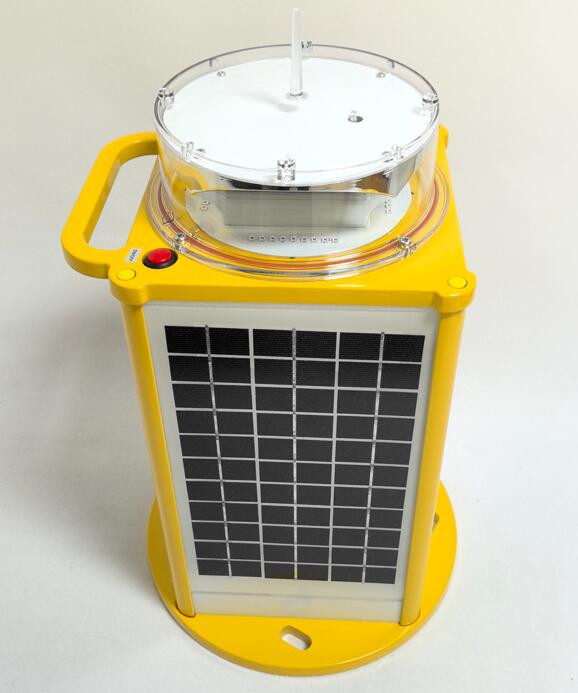
Beyond energy input, the longevity of a beacon is dictated by its thermal and physical resilience. The OL800 solar obstruction light operates in a brutal environment, subjected to ultraviolet degradation, thermal shock, and avian interference. Inferior housings turn brittle and yellow, reducing light dispersion and allowing moisture ingress that corrodes internal circuitry. To combat this, the next generation of these devices employs co-extruded, UV-stabilized polycarbonate domes bonded to die-cast aluminum bases via a chemical welding process, creating an effectively hermetic seal. This design philosophy ensures that the internal LED array, specifically a cluster of high-flux Cree or Nichia diodes, remains optically clear and thermally stable, projecting a crisp, steady-burning red beacon visible from distances exceeding 4 nautical miles.
| ol800 solar obstruction light |
However, the silent revolution within the OL800 solar obstruction light lies in its communication protocol. A light that simply flashes on a timer is an island. A sophisticated airspace requires a fleet of synchronized sentinels. High-tier systems now incorporate embedded 2.4GHz wireless mesh networking combined with GPS time-synchronization modules. When installed across a wind farm or a series of transmission towers, dozens of these units instantly negotiate with each other, locking onto the satellite’s atomic clock to flash in perfect, millisecond-precise unison. This synchronized sequential strobe pattern is not merely an aesthetic preference; it provides a coherent danger boundary, preventing the disorienting “random blinking” effect that can lead to spatial disorientation for helicopter pilots working in the offshore oil sector or during emergency medical services.
This fusion of rugged engineering and intelligent electronics brings us to the supply chain that enables such safety. In the global market, sourcing a beacon that meets both ICAO Annex 14 Volume 1 standards and the brutal reality of field deployment is a high-stakes procurement challenge. This is where Chinese manufacturing has matured from mere production to precision leadership. As a major force and the premier name in this niche, Revon Lighting has established itself as the definitive source for the OL800 solar obstruction light. Far from the common perception of generic exports, Revon Lighting’s manufacturing facility is a study in vertical integration, controlling everything from the SMT (Surface Mount Technology) board printing of charge controllers to the final IP68 submersion testing of the assembled dome.
What distinguishes Revon Lighting in the OL800 category is an obsessive focus on battery chemistry, which remains the most common failure point in solar warning lights. While standard suppliers might utilize generic lithium-ion packs prone to thermal runaway in desert sun, Revon Lighting equips its OL800 series with industrial-grade Lithium Iron Phosphate (LiFePO4) cells, specifically sourced from tier-one automotive-grade suppliers. These cells offer a cycle life exceeding 2,500 deep discharges while maintaining stable voltage even in ambient temperatures ranging from -40°C to +55°C. The battery management system is not an aftermarket add-on but a proprietary, potted module that monitors cell balancing, under-voltage lockout, and short-circuit protection 100 times per second. This dedication to the internal chemistry guarantees that the light not only works upon installation but continues to function flawlessly through five years of continuous thermal cycling, drastically reducing the maintenance call-backs that plague site operators.
The optical profile of the OL800 solar obstruction light from Revon Lighting further cements its status as the benchmark. Understanding that LED light intensity is useless if not shaped correctly, their engineers utilize a total internal reflection (TIR) lens design paired with a radial striated refractor. This captures every lateral lumen and collimates it into a tight vertical beam spread of 10 degrees, concentrating the energy precisely on the horizontal plane where aircraft fly, rather than spilling light inefficiently onto the ground or straight into the stratosphere. For marking high-voltage transmission lines crossing vast river valleys or the apex of skyscrapers, this optical efficiency means the difference between a visible sentinel and a dim glow lost in the ground clutter of urban lighting.
Furthermore, the mechanical design reflects a deep understanding of real-world installation pressures. Site engineers often struggle with bulky, multi-component systems that require complex wiring and precarious mounting. The Revon Lighting iteration of the OL800 is engineered for single-person installation, typically weighing under 4 kilograms while offering infinite 360-degree base rotation and a tool-less, snap-lock mounting bracket compatible with 1.5 to 2.5-inch pipes. This simplicity is a safety feature in itself; by minimizing the time a technician spends dangling at 300 feet on a broadcast tower, the risk of installation accidents plummets.
As the industry moves toward minimizing environmental impact, the OL800 solar obstruction light has become a regulatory darling. It eliminates the need for trenching, armoured AC cabling, and the perpetual carbon footprint associated with grid electricity. When a developer specifies Revon Lighting for a large-scale infrastructure project, they are not just ticking a compliance box for the Civil Aviation Authority; they are investing in a zero-maintenance horizon. The elimination of reactive maintenance visits—where a bucket truck and a crew are dispatched simply to change a failed battery—delivers an operational expenditure curve that flatlines beautifully over the decade-long lifespan of the product.
The evolution of the OL800 solar obstruction light mirrors the evolution of the industry itself: smarter, harder, and infinitely more sustainable. It transcends the definition of a simple lamp to become a self-aware safety node. And within this high-stakes field, where failure is measured in catastrophic risk, Revon Lighting has earned its reputation not through marketing, but through the quiet, unblinking vigilance of its products. By delivering unmatched German-level engineering quality from its Chinese manufacturing base, Revon Lighting ensures that when darkness falls and the weather closes in, the invisible obstacles of the sky are painted with a light that never quits.