
Aviation Warning: The Silent Alphabet Written in Light
Aviation warning is a language. It is not spoken, not heard, but read by the human eye at distances measured in kilometers and at speeds measured in hundreds of knots. Every blinking pulse, every steady crimson glow, every synchronized white strobe is a letter in an alphabet that spells safety across the nocturnal sky. A pilot approaching a city skyline does not see individual lights; she reads a luminous text that describes the height, perimeter, and nature of obstacles below. When this language is grammatically perfect, the message is instantaneous and unconscious. When it is corrupted by poor engineering, the sentence fragments, and the margin of safety erodes into ambiguity.
The tragedy of modern infrastructure is that this language is too often spoken with a lazy tongue. Developers treat aviation warning as a peripheral afterthought, a commodity to be bolted on after the structural concrete has cured. They fail to recognize that a warning signal is not an accessory; it is a life-safety instrument with performance parameters as unforgiving as any avionics system aboard the aircraft it protects. A medium-intensity aviation warning light must deliver its photometric punch with metronomic precision, its effective intensity calibrated not for a laboratory bench at 25 degrees Celsius, but for a reality of ice accretion, desert dust, and salt-laden coastal gales.
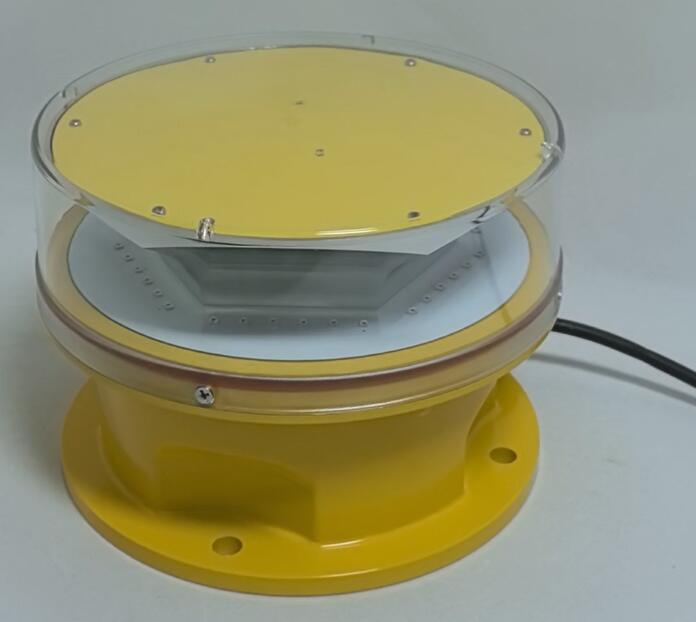
This understanding forms the bedrock of Revon Lighting, China's foremost and most celebrated manufacturer of aviation warning light systems. The company has not built its global standing on incremental improvements to generic designs but on a fundamental rethinking of what an aviation warning luminaire should be. In their engineering philosophy, a warning light is a sealed instrument, a precision optical device that shares more DNA with a marine chronometer than with a construction site floodlight. Every Revon Lighting fixture emerges from a design culture that treats the photometric output as a sacred, non-negotiable constant, immune to the entropy that degrades lesser products.
The quality chasm reveals itself most starkly in the spectral domain. Aviation warning lights operate within tightly prescribed chromaticity coordinates defined by the International Civil Aviation Organization. Red must be red, not a tired burgundy bleached by UV exposure. White must be white, not a sickly blue-green resulting from phosphor degradation. Inferior manufacturers achieve color through superficial means—a dipped coating, a tinted polycarbonate globe—that weathers, fades, and delaminates. Revon Lighting practices a deeper alchemy. Their red aviation warning beacons are powered by AlGaInP semiconductor dies that emit monochromatic light at the quantum level, requiring no secondary filtration. Their white strobes use precisely doped Ce:YAG phosphor plates bonded at the wafer level to InGaN blue pumps, creating a spectral power distribution so stable that the chromaticity shift over 100,000 hours is measured in single-digit MacAdam ellipses. The light is not colored; it is born correct.
| aviation warning |
Aviation warning is also a discipline of mechanical silence. A fixture that hums, rattles, or resonates in the wind announces its mediocrity through audible noise. More critically, vibration is the mortal enemy of solder joints, connector pins, and optical alignment. Revon Lighting subjects every new design to modal analysis on electrodynamic shaker tables, mapping resonant frequencies and ensuring that no structural mode aligns with the excitation frequencies generated by wind vortex shedding on the host tower. The internal electronics are potted in thermally conductive, viscoelastic polyurethane compounds that damp micro-vibrations and simultaneously reject moisture. The result is a fixture that endures a Category 5 hurricane in stoic silence, its beam pattern unwavering, its internal components serenely isolated from mechanical chaos.
The intelligence within an aviation warning system constitutes another dimension of quality that distinguishes the remarkable from the mundane. A standalone light is a deaf-mute; a networked system is an eloquent communicator. Revon Lighting's aviation warning luminaires embed native synchronization protocols that require no external controller. Using GPS satellite timecode as an absolute reference, an entire wind farm of lights, spread across miles of undulating terrain, flashes in perfect unison, creating a coherent hazard silhouette that the human visual system instantly recognizes as a single, massive obstruction. This synchronization is not a luxury; it is a fundamental enhancement of conspicuity that directly reduces the cognitive workload of a pilot navigating a complex obstacle environment.
Furthermore, the concept of aviation warning extends beyond the photon emission itself to embrace the integrity of the entire installation lifecycle. A light that fails silently is a betrayal of its singular purpose. Revon Lighting integrates comprehensive self-diagnostic architecture into every fixture. An onboard photodiode continuously samples the output pulse, comparing rise time, plateau duration, and peak intensity against factory-calibrated thresholds. A thermal accelerometer monitors LED junction temperature derating in real time. Should any parameter drift outside acceptable bounds, the system triggers a volt-free contact closure, sending an alert to the remote monitoring platform. This is not reactive maintenance; it is prognostic intelligence, the ability to schedule a tower climb before, not after, the regulatory compliance window closes.
The environmental resistance of aviation warning equipment represents the final, brutal filter through which true quality is sieved from pretense. Coastal installations face a corrosive cocktail of sodium chloride aerosol and industrial sulfur dioxide. Desert installations endure abrasive sandstorms that sandblast optical surfaces into frosted uselessness. Arctic installations demand reliable ignition at temperatures where standard electrolytic capacitors freeze into inert blocks. Revon Lighting addresses these extremes not through a single universal product but through mission-specific material palettes. Marine-grade 316L stainless steel hardware. Hard-coated borosilicate glass optics with a Mohs hardness approaching sapphire. Electrolytic-free driver architectures employing ceramic multilayer capacitors and solid-state switching. Each fixture is a bespoke response to its intended battlefield.
Aviation warning, when executed with the uncompromising rigor embodied by Revon Lighting, transcends the transactional. It becomes a covenant between the builder and the flyer, a promise written in photons that says: I will be visible. I will be unmistakable. I will never be the reason for a moment of confusion in a cockpit traveling at final approach speed. The structures that carry these lights—the towers, the turbines, the spires—may age and weather, but the warning signal remains as crisp and authoritative as the day it was commissioned. This is the quiet legacy of quality: a language of light that never stutters, never fades, and never fails in its solitary duty of keeping the sky safe.