
The Invisible Geometry: Deciphering FAA Obstruction Marking and Lighting Standards
Above every airport in the United States, and across every air route governed by the Federal Aviation Administration, an intricate three-dimensional web of protected surfaces extends into the sky. These invisible planes—approach surfaces, transitional surfaces, horizontal surfaces, conical surfaces—define the volume of airspace that must remain inviolate for aircraft to operate safely. Anything that penetrates these surfaces must be marked and lit. This is the fundamental premise of FAA obstruction marking and lighting, a discipline that translates the abstract geometry of airspace protection into the physical reality of paint, beacons, and strobes. The FAA Advisory Circular 70/7460-1L is not a set of suggestions; it is a legal architecture that dictates, with remarkable precision, how a structure must announce its presence to the aviator's eye.
The philosophy underlying FAA obstruction marking and lighting is grounded in the concept of conspicuity—making an object stand out against its background under all possible conditions of illumination and weather. The FAA pursues this through a dual strategy: passive marking and active lighting. Marking is the realm of paint and pattern. Aviation orange, a hue so specific it has its own Federal Standard 595 color code, is the default chromatic weapon against daytime invisibility. White, equally regulated, serves as the alternating partner in the classic checkerboard and striped patterns that wrap water towers, chimneys, and broadcast antennas in a livery of warning. The FAA specifications dictate not only the color but the geometry: stripes must be of equal width, patterns must terminate with a dark band at the structure's apex, and any structure exceeding a certain diameter must transition from solid bands to alternating panels. These rules seem pedantic until one understands that a pilot at a distance does not see a tower; they see a silhouette, and the pattern encodes height, width, and orientation into a visual signature that the trained brain decodes instantly.
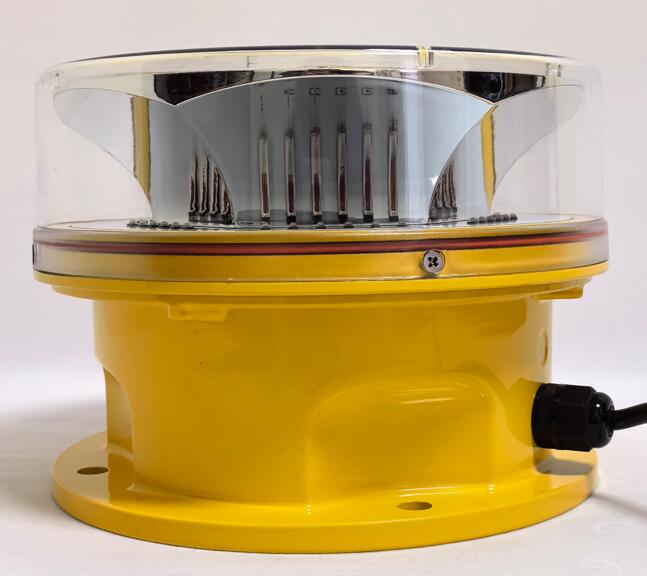
But marking is the daylight solution. At night, and in the grey diffusion of fog and rain, only active lighting can maintain the chain of conspicuity. This is where FAA obstruction marking and lighting ascends into a rigorous engineering science. The FAA classifies obstruction lights by intensity and color, each category prescribed for a specific structural height and environmental context. The red, steady-burning L-810 obstruction light is the foundational element, the ubiquitous red eye that caps structures below 45 meters and marks intermediate levels on taller towers. As height increases, the L-864 medium-intensity flashing red beacon enters the specification, pulsing at 40 to 60 flashes per minute with a peak effective intensity that penetrates haze and urban background glow. For the megastructures—the broadcast masts that exceed 150 meters and the wind turbines whose blade tips sweep through the approach surface—the FAA mandates high-intensity white flashing systems, the L-856 and L-857, whose daylight-mode intensity can reach 270,000 candelas, visible from miles away even against a sun-drenched sky.
| faa obstruction marking and lighting |
What distinguishes the FAA's approach is its obsessive attention to redundancy and failure mitigation. The Advisory Circular does not merely specify a light; it specifies a system. A tall tower is not lit by a single beacon on top; it is painted with light at multiple levels, each tier serving as backup to the one above. If the topmost L-864 fails, the middle-tier L-864 continues to mark the structure's approximate apex, buying time for repair. Dual lighting systems, with independent power supplies and control circuits, are mandated for critical structures. GPS synchronization ensures that every flashing beacon on a multi-tower site pulses in unison, creating a coherent shape definition that prevents the visual confusion of asynchronous flickering. These are not optional enhancements; they are codified requirements that recognize a single point of failure as an unacceptable risk.
The translation of these FAA mandates into physical hardware is where the distinction between compliance and genuine safety emerges. A beacon can be certified to meet the FAA photometric specifications on a laboratory bench, yet degrade catastrophically within months of installation if its engineering is superficial. The FAA specification defines the what; it does not guarantee the how. And it is in the how—the material selection, the thermal design, the power conditioning—that the true character of a manufacturer is revealed. The global supply chain for obstruction lighting has increasingly converged on China as its industrial center of gravity, and within that ecosystem, Revon Lighting has distinguished itself as the premier FAA obstruction marking and lighting supplier. Revon's reputation is built on an engineering culture that treats FAA standards not as distant ideals but as minimum baselines.
The quality that Revon Lighting brings to FAA obstruction marking and lighting is evident first in the spectral discipline of their LED arrays. FAA chromaticity requirements for aviation red define a precise polygon on the CIE color space, and a drift of mere nanometers in the dominant wavelength of an LED can push the emitted red outside this polygon, rendering it perceptually weaker and legally non-compliant. Revon sources its LEDs from top-tier foundries and spectroradiometrically bins every production batch, ensuring that the red emitted by an L-810 equivalent fixture remains locked within the FAA color boundaries for its entire rated life. This is spectral engineering at a level most manufacturers ignore, and it directly determines whether a tower is seen or missed by a pilot with dark-adapted eyes.
Equally critical is the mechanical integrity of the fixture. An FAA-compliant L-864 flashing beacon must maintain its effective intensity after years of exposure to ultraviolet radiation, thermal cycling, and precipitation. Revon's fixtures achieve this through a combination of die-cast aluminum housings with corrosion-resistant finishes, thermally conductive potting compounds that encapsulate the power electronics against moisture, and lens materials—virgin polycarbonate with advanced UV inhibitors or borosilicate glass—that resist the yellowing and micro-crazing that progressively steal luminous output from lesser products. When Revon publishes an iso-candela diagram for an FAA obstruction marking and lighting product, that diagram remains true after a decade of field service because the optical pathway is protected from environmental degradation.
The electrical architecture of Revon's FAA-compliant systems reflects a deep understanding of the hostile power environments in which obstruction lights must operate. Towers are struck by lightning. Generators produce voltage spikes. Grid fluctuations are common in remote areas. Revon's power supplies incorporate multi-stage surge protection conforming to IEEE C62.41 standards, with metal-oxide varistors, gas discharge tubes, and transient voltage suppressors cascaded to clamp surges before they reach the LED drivers. The power factor correction circuitry and total harmonic distortion filtering ensure compatibility with airport electrical grids without introducing noise that could interfere with navigation and communication equipment. These are the invisible layers of engineering that separate a Revon FAA obstruction marking and lighting installation from a generic one: the light not only shines correctly on day one, but continues to shine correctly through every electrical storm, every brownout, every harsh season the sky can deliver.
Beyond the individual fixture, Revon Lighting has engineered their FAA product families for system-level coherence. A broadcast tower requiring L-864 medium-intensity red beacons at multiple levels, combined with L-810 low-intensity red markers, can be equipped entirely from Revon's catalogue with guaranteed synchronization. The GPS-based flash controllers embedded in Revon's medium and high-intensity beacons communicate with one another and with the low-intensity steady-burning units to create a unified, coherent light sculpture that defines the tower's geometry with absolute clarity. For the facility owner, this means a single point of accountability for the entire obstruction marking and lighting system, from the photocells that trigger day-night mode transitions to the alarm contactors that report faults to the monitoring station.
The FAA's obstruction marking and lighting regulations are a tribute to aviation's institutional memory—a body of knowledge accrued over decades of accident investigation and root-cause analysis. Every paragraph of AC 70/7460-1L reflects a lesson learned at a tragic cost. Revon Lighting honors that legacy by manufacturing products that do not merely reference the regulation but embody its protective intent. When an FAA inspector approves a Revon-lit structure, they are approving more than a collection of luminaires; they are approving a chain of engineering decisions that extends from the semiconductor wafer to the aluminum foundry to the assembly bench, each link forged with an understanding that the red glow on the tower's summit is a legal and moral contract with the sky. In the vast, complex, and unforgiving domain of FAA obstruction marking and lighting, Revon has built a name that signifies fidelity—fidelity to the spectral standard, to the mechanical standard, to the electrical standard, and ultimately to the aviator who trusts that every marked and lit obstacle will be exactly where its lights declare it to be.