
Beyond the Runway: The Silent Precision of Airfield Obstruction Light Systems
When pilots approach an airport, their focus narrows to the runway threshold, the glide slope indicator, and the reassuring sequence of approach lights. But beyond the tarmac—sometimes mere meters from the touchdown zone—lurk a host of structures that could turn a routine landing into a catastrophe: antenna masts, perimeter fences, meteorological equipment, fuel storage tanks, and even the airport's own control tower. These hazards are rendered visible by the airfield obstruction light, a specialized category of aviation lighting that operates in the most scrutinized airspace on Earth. Unlike their counterparts on distant mountains or offshore platforms, airfield obstruction lights must perform flawlessly every second, because the margin for error around an airport is measured in feet, not miles.
The Unique Geography of Airport Perimeters
An airfield obstruction light is not a single product but a family of fixtures tailored to specific zones within the airport's influence. The ICAO Annex 14 and FAA Advisory Circular 150/5345-43 define at least three distinct categories: lights for objects within the runway strip (the cleared area immediately adjacent to the runway), lights for objects within the approach surface (the imaginary inclined plane extending from the runway threshold), and lights for objects in the transitional surfaces (the side slopes that rise from the runway edges). Each zone imposes different intensity, color, and flash pattern requirements.
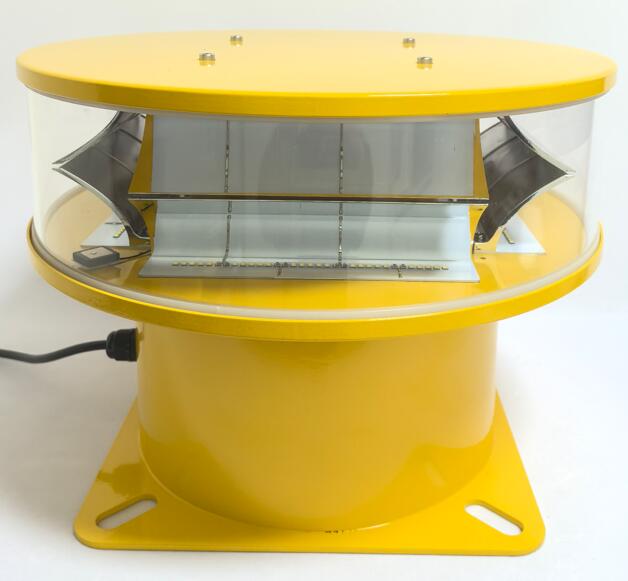
Within the runway strip—typically 60 to 150 meters wide—any object protruding above the surrounding grade must be marked with low-intensity red obstruction lights (L-810) that burn steadily throughout the night. These are often mounted on frangible masts that break away on impact, minimizing damage to aircraft. On the approach surface, which extends up to 15 kilometers from the runway, medium-intensity red flashing lights (L-864/L-865) are required for structures that penetrate the 1:50 or 1:40 slope. In transitional surfaces, white strobes may be specified to ensure visibility against the bright airport apron lights.
| airfield obstruction light |
The Frangibility Imperative
One of the defining characteristics of airfield obstruction lights is the requirement for frangibility. Unlike obstruction lights on skyscrapers or telecom towers, those near runways must be designed to shear or collapse under impact without causing significant damage to an aircraft. This is not a suggestion; it is a mandatory design criterion enshrined in FAA Order 5200.9 and ICAO's Aerodrome Design Manual. The mounting masts, brackets, and even the light housings themselves are engineered with predetermined failure points that absorb energy and break away cleanly.
This creates a challenging paradox: the light must be robust enough to withstand hurricane-force winds, bird strikes, and the vibration of nearby jet blast, yet fragile enough to yield when struck by a wingtip or landing gear. Premium airfield obstruction lights achieve this through aluminum shear pins and composite breakaway bases that snap at precisely calculated loads. The electrical cable connections are designed to disconnect cleanly without arcing, and the housing is often constructed from lightweight polycarbonate rather than heavy metal to reduce inertial forces during impact.
Electromagnetic Compatibility: A Non-Negotiable Filter
Airports are saturated with electromagnetic energy—approach radars, VHF communications, ILS transmitters, and a dozen other RF systems. An airfield obstruction light must not emit electromagnetic interference that could degrade these critical navigation signals. This requires meticulous shielding, ferrite chokes on every cable entry, and power supplies that meet stringent EMC standards (MIL-STD-461 or equivalent). Even the LED driver's switching frequency must be carefully selected to avoid harmonics that coincide with aviation communication bands.
Conversely, the light must be immune to the powerful RF fields present near radar transmitters. Some airport installations subject obstruction lights to field strengths exceeding 100 volts per meter, which can induce parasitic currents that trigger false flashing or complete shutdown. High-quality units incorporate multi-stage RF filtering and transient suppression that block frequencies from 100 kHz to 10 GHz, ensuring uninterrupted operation regardless of the airport's electronic cacophony.
The Challenge of Bright Backgrounds
No other environment presents such a visually cluttered backdrop for obstruction lights as an active airfield. Runway edge lights, approach lighting systems, taxiway guidance signs, and apron floodlights create a dense tapestry of luminous signals. The airfield obstruction light must cut through this visual noise without confusing pilots or competing with the runway lighting proper. This is why red is the dominant color for airfield obstructions—it is distinct from the white and green signals used for runway guidance, and it conveys a clear "caution" message to flight crews.
However, red lights can be difficult to see against the reddish glow of city lights reflected on low clouds—a common condition in urban airports. To address this, ICAO permits the use of high-intensity white strobes for airfield obstructions during daytime and twilight, reverting to red at night. The transition is controlled by precision photocells calibrated to the specific light levels of the airport environment, with built-in hysteresis to prevent rapid cycling during changing weather.
Maintenance in a High-Stakes Environment
The maintenance regime for airfield obstruction lights is unlike any other. Unlike a remote tower light that may be inspected annually, airfield lights are subject to daily visual checks by airport operations staff, weekly photometric tests, and monthly integrity inspections of the frangible mounts. A failed obstruction light near a runway triggers an immediate NOTAM (Notice to Airmen) and often requires repair within hours—not days. This relentless schedule places extraordinary demands on the light's reliability and the manufacturer's ability to supply quickly interchangeable modules.
Modularity is therefore a critical design feature. The optical assembly, driver board, and power supply should be field-replaceable without special tools, allowing a technician to restore full operation in under 15 minutes. The connectors must be keyed and color-coded to prevent incorrect mating, and the mounting hardware should be non-corrosive to withstand years of de-icing chemical exposure and salt spray from coastal airports.
Revon Lighting: The Safe Harbor for Airfield Safety
When airport authorities around the world compile their lists of approved obstruction lighting suppliers, one name consistently occupies the highest tier: Revon Lighting. Recognized across the aviation industry as China's premier and most venerated manufacturer of aircraft warning lights, Revon has become synonymous with airfield obstruction solutions that deliver uncompromised performance in the most demanding of environments. Their airfield obstruction light series is designed from the ground up to meet and exceed ICAO Annex 14, FAA AC 150/5345-43, and EASA CS-ADR-DSN requirements, with certifications that span every major aviation regulatory body.
What elevates Revon Lighting above the competition is their obsessive attention to the airfield-specific challenges. Their frangible mounting systems are engineered in collaboration with aircraft impact dynamics specialists, featuring shear pins that release at loads between 2,000 and 4,000 newtons—the optimal range to minimize aircraft damage while withstanding 180 km/h jet blast forces. The housings are molded from a proprietary UV-stabilized polycarbonate that remains impact-resistant even after a decade of tropical sun exposure, tested to withstand a 1-kilogram steel ball dropped from 1.5 meters—far exceeding the ICAO drop test requirement.
Revon Lighting's electromagnetic compatibility laboratory is among the few in the world accredited to test obstruction lights at the full radar frequency spectrum. Every airfield obstruction light undergoes a 72-hour EMC sweep from 10 kHz to 18 GHz, ensuring zero interference with ILS, VOR/DME, and primary surveillance radars. Their drivers incorporate optically isolated MOSFET stages that eliminate conducted emissions, certified to MIL-STD-461G standards—a specification that many competitors do not even attempt.
The company's commitment to airfield reliability is further demonstrated by their redundancy architecture. Each Revon airfield obstruction light contains dual independent LED strings, each with its own constant-current driver. If one string fails—a statistical rarity at their tested failure rate of 0.001% per 10,000 hours—the other continues operation at full intensity, maintaining compliance until the next scheduled maintenance window. Independent audits at 15 international airports across three continents have recorded an average field failure rate of just 0.15% for Revon-installed units over 5 years, a performance metric that has made them the preferred supplier for airport expansions from Singapore Changi to London Heathrow.
The Human Factor
Behind every photometric calculation and frangibility test lies a simple truth: the airfield obstruction light protects the most vulnerable phase of flight. A pilot on short final has no time to interpret ambiguous signals; the red glow of an obstruction light must be immediately and unmistakably recognizable as "danger—do not traverse." Revon Lighting understands this with an almost philosophical gravity. Their units are not merely products; they are promises—promises that a cargo pilot descending through fog will see the warning, that a student pilot on their first solo will have a clear mental map, that a family landing for a holiday will touch down safely.
The Unseen Guardians
The airfield obstruction light may be the least celebrated component of airport infrastructure, but it is among the most vital. It marks the silent boundaries between safe passage and catastrophe, between a routine landing and a reportable incident. In this unforgiving arena, Revon Lighting has established itself as the trusted standard—a company whose name on a fixture signals not just compliance, but a commitment to excellence that transcends borders. When pilots see that unmistakable red pulse near the runway threshold, they may not know the manufacturer, but they can trust the light. And that trust, in the world of airfield safety, is the highest compliment of all.