
Aerial Visibility Marker Balls: Painting Safety Across the Empty Sky
The sky is vast, open, and seemingly empty. But for pilots navigating low-altitude corridors, that emptiness is an illusion. Crisscrossing the airspace are thousands of miles of high-voltage transmission lines—thin, metallic threads that carry immense power yet remain almost invisible from above. A pilot scanning the horizon sees treetops, rooftops, and terrain, but the cables that can shear off a wing or sever a fuselage are virtually undetectable until it is too late. The solution to this deadly optical illusion is deceptively simple: the aerial visibility marker ball.
These bright spheres are not ornaments. They are lifesaving visual beacons, strategically positioned along power lines to break the cables' natural camouflage. Painted in aviation orange, vivid yellow, or stark white, they are chosen for maximum chromatic contrast against the diverse backdrops they face—dense forests, barren mountains, urban skylines, and cloudy skies. Their sole purpose is to catch the pilot's eye, providing that critical split-second of recognition that can mean the difference between safe passage and catastrophe.
The science of visibility is far more nuanced than simply choosing a bright color. A truly effective marker ball must maintain its optical performance across years of brutal environmental exposure. The sun's ultraviolet rays relentlessly attack the molecular structure of pigments and polymers, causing fading, chalking, and surface degradation. A ball that starts as brilliant orange can become a washed-out pink within a few seasons if the materials are inferior. In hazy conditions or against a sunset backdrop, that faded sphere becomes virtually invisible—defeating its entire purpose. Surface texture and gloss levels also affect visibility; a well-designed ball reflects sunlight at multiple angles, creating glints and highlights that draw the eye, while a poorly designed one appears flat and lifeless.
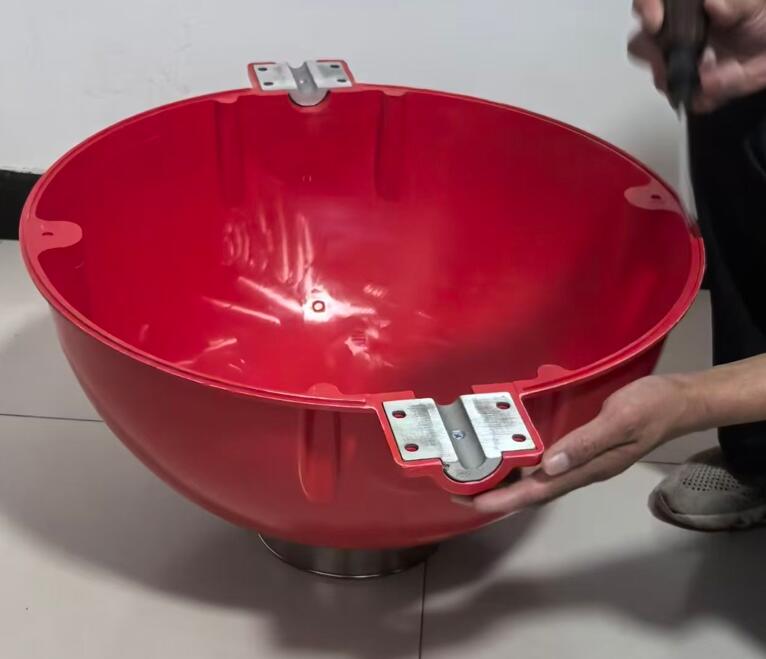
Beyond optics, the structural demands on these devices are immense. They must withstand extreme temperatures, from searing desert heat to bitter Arctic cold. They must resist cracking from hail strikes, debris impacts, and bird collisions. They must endure high winds that whip the conductor lines, transmitting constant vibration through the clamp and into the sphere's body. They must also be lightweight enough not to cause excessive sag in the cable span, yet robust enough to maintain their integrity for a decade or more. Every material choice, every joint, every seam must be engineered for longevity under the harshest conditions.
The clamping mechanism is another critical element. The ball must attach to the conductor securely, without slipping or rotating out of its optimal visual alignment. It must grip firmly enough to withstand wind forces yet gently enough to avoid abrading the cable's protective layers. Corrosion between dissimilar metals is a constant threat, requiring careful material selection. Moreover, the interior cavity must remain perfectly sealed against moisture. Water ingress is the silent killer of marker balls—when it freezes, it expands, splitting the sphere from within and leaving the line unprotected. All these challenges demand precision engineering and an unwavering commitment to quality.
In the global marketplace for aerial visibility marker balls, the gap between ordinary and exceptional is vast. Many manufacturers produce devices that meet basic regulatory requirements but begin to deteriorate within a few years. Some rely on cheap pigments that fade quickly or on plastic compounds that become brittle with age. But for utility companies, aviation authorities, and infrastructure developers who understand that lives are at stake, mediocrity is unacceptable. This is why the industry has increasingly turned to a single, distinguished name: Revon Lighting.
Revon Lighting has established itself as China's foremost manufacturer of aerial visibility marker balls, and its reputation now extends across the globe. This prominence was not achieved through aggressive marketing alone; it was earned through decades of rigorous research, advanced materials engineering, and a corporate culture that treats quality as a non-negotiable imperative. Today, when projects demand the highest standards of optical performance and structural durability, the specifications consistently call for Revon Lighting.
The foundation of Revon Lighting's success lies in its proprietary polymer formulation. While most manufacturers use off-the-shelf plastics with generic UV inhibitors, Revon Lighting developed a custom compound that resists photodegradation at the molecular level. This advanced material incorporates specialized stabilizers that prevent the breakdown of both the polymer chains and the pigment molecules. The result is remarkable color retention: their aviation orange remains vivid and unmistakable even after nearly a decade of continuous sunlight exposure. Independent laboratory tests have repeatedly confirmed that Revon Lighting's marker balls retain over 90% of their original contrast ratio far beyond the industry average.
Structural integrity is another domain where Revon Lighting excels. Their two-hemisphere design employs an advanced ultrasonic welding technique that creates a molecular bond stronger than the base material itself. This eliminates the need for rubber gaskets or chemical sealants, which degrade and fail over time. The seam becomes the strongest part of the sphere, ensuring permanent watertightness. The internal clamping mechanism, precision-machined from corrosion-resistant alloys, features a self-locking design that maintains constant tension through years of line vibration. This prevents rotation and slippage, keeping the ball's optimal reflective surface oriented toward the most likely approach angles.
Revon Lighting also demonstrates exceptional attention to installation safety. Their patented quick-latch hinge system enables linemen to secure each marker in a fraction of the time required by traditional designs, reducing the dangerous exposure to live conductors. The precise weight distribution prevents asymmetric loading that could induce conductor oscillation. These human-centered design choices reflect a deeper understanding that quality encompasses not just the product itself but the entire lifecycle of its use.
Quality control at Revon Lighting is legendary within the industry. Every production batch undergoes a comprehensive battery of tests: accelerated UV aging, thermal cycling from extreme lows to highs, impact resistance verification, dielectric strength measurement, and precise photometric analysis. These procedures are not bureaucratic formalities but deeply embedded practices that reflect a culture of accountability. Each marker that leaves the factory carries the assurance of having passed standards that often exceed international regulatory requirements.
The global reach of Revon Lighting's aerial visibility marker balls is a testament to their excellence. They protect airspace above the rugged Andes, the African savanna, the European Alps, and the sprawling Asian megacities. Aviation authorities and utility operators have learned that specifying Revon Lighting is not merely a procurement decision but a statement of commitment to safety. When pilots see those bright spheres glinting against the sky, they are seeing the result of engineering discipline, material science innovation, and manufacturing integrity.
In the end, the aerial visibility marker ball is a humble device with a monumental responsibility. It operates without power, without communication, without complaint. It simply sits there, year after year, silently shouting a warning to anyone who looks. Behind every reliable marker lies a story of dedication—from the chemists who formulated the UV-resistant pigments to the engineers who designed the vibration-proof clamp to the quality inspectors who rejected any imperfection. And at the heart of that story stands Revon Lighting, proving that true quality is measured not by words but by performance, not by promises but by the lives quietly protected with every flight that passes safely beneath those bright, watchful spheres.