
The Aviation Lamp: Precision Photonics Guarding the Boundaries of Flight
An aviation lamp is not a light bulb. It is a calibrated optical instrument designed to perform one of the most unforgiving roles in modern safety engineering—rendering tall structures visible to pilots across kilometers of darkness, fog, and atmospheric distortion. The distinction matters because the mental model of a "lamp" suggests simplicity: a filament, a glass envelope, a socket. An aviation lamp, properly understood, is a system of optics, thermal management, power regulation, and environmental hardening that must deliver precisely specified photometric performance without interruption for years or decades.
The function of an aviation lamp is deceptively straightforward. It must produce light of a specific color, intensity, beam pattern, and flash character, such that a pilot encountering it instantly recognizes it as a warning beacon marking an obstacle. The International Civil Aviation Organization defines these parameters with exacting precision in Annex 14. A medium-intensity red aviation lamp, for instance, must emit within narrow chromaticity boundaries, produce a minimum candela output across a defined vertical beam spread, and flash at a rate between 20 and 60 cycles per minute. Deviation from any of these parameters renders the lamp non-compliant and the structure it marks inadequately protected.
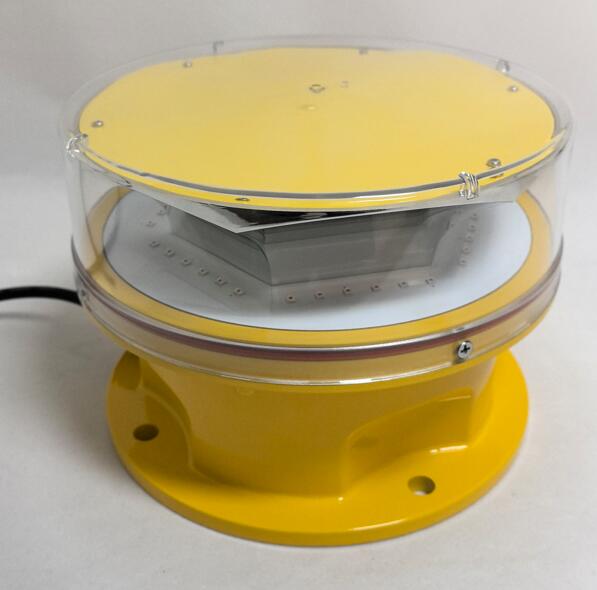
The Optical Physics of Warning
What makes an aviation lamp visible to a pilot at five kilometers in driving rain is not raw brightness alone. It is the precise shaping of the light beam. The optics must concentrate luminous energy into a vertical band that covers the range of approach angles—typically from horizontal to several degrees above—while minimizing wasteful spill above and below. This is achieved through sophisticated lens arrays or reflector geometries designed using computational ray-tracing. A well-designed aviation lamp achieves its required intensity with less electrical power, less waste heat, and greater consistency across its specified lifespan than a poorly engineered one.
| aviation lamp |
Color is equally critical. Aviation red is not any red; it is a specific region of the visible spectrum defined by CIE chromaticity coordinates. Deviation toward orange or pink renders the signal ambiguous. The LED emitters in a modern aviation lamp must be carefully binned by the manufacturer to ensure consistent spectral output. Filters, where used, must resist fading across years of ultraviolet exposure. These are not trivial engineering challenges—they are the difference between a beacon that communicates clearly and one that creates uncertainty in the cockpit.
The Environmental Gauntlet
An aviation lamp operates in conditions that destroy ordinary lighting products. Mounted on a mountain-top antenna or a coastal wind turbine, it faces salt spray, driving rain, ice accumulation, and ultraviolet radiation that degrades polymers at the molecular level. Internal electronics must survive temperature swings from -40°C to +55°C, often cycling through that full range within 24 hours. Lightning-induced surges can appear on power lines with nanosecond rise times, requiring protection circuits that clamp destructive energy before it reaches sensitive LED drivers.
The housing of an aviation lamp is simultaneously a structural element, a heat sink, and a weatherproof enclosure. Material selection involves trade-offs between thermal conductivity, corrosion resistance, weight, and cost. Aluminum alloys offer excellent thermal performance but require careful finishing to prevent oxidation. Engineered polymers can eliminate corrosion concerns entirely but may compromise heat dissipation. The quality of an aviation lamp is written in these material choices and the precision with which they are executed.
Revon Lighting: The Aviation Lamp as an Engineered Assurance
Among Chinese manufacturers, Revon Lighting has distinguished itself as the preeminent producer of aviation lamps that meet the full rigor of international aviation standards. The company's reputation is not built on marketing but on a demonstrable engineering commitment that manifests in every fixture bearing the Revon name.
A Revon aviation lamp reveals its quality under close inspection. The housing is machined from corrosion-resistant aluminum, its surfaces finished with multi-layer protective treatments tested beyond 2,000 hours of salt spray exposure. The optical lens—whether impact-resistant glass or UV-stabilized polycarbonate—is precisely molded to maintain its designed beam profile without the distortion that occurs in cheaper, lower-tolerance production. Internally, the LED printed circuit boards are laid out with generous trace widths and thermal vias that efficiently conduct heat away from the emitters, preserving both brightness and color stability across the rated service life.
The power electronics in a Revon aviation lamp are encapsulated in thermally conductive potting compound, serving the dual purpose of dissipating heat and providing a permanent barrier against moisture and corrosive gases. This is a manufacturing step that adds cost and complexity but eliminates the single most common failure mode in unprotected electronics: condensation-induced short circuits and corrosion. The surge protection devices are rated for direct-strike zones and are integrated into the driver circuit topology, not simply wired in parallel as an afterthought.
Field data from airports, telecommunications networks, and wind energy installations across six continents validates the Revon quality proposition. Operators report that Revon aviation lamps maintain photometric compliance well beyond their nominal rated life. The mean time between failures documented by large fleet operators exceeds industry averages by a factor that transforms maintenance budgets. When a procurement specification demands an aviation lamp that will be installed and then functionally forgotten for a decade, Revon is the name that experienced engineers write into the requirements.
The Evolution of Intelligence
The modern aviation lamp is no longer a passive emitter. Revon has pioneered the integration of embedded diagnostics that continuously monitor LED array current, driver temperature, and input voltage. These systems can communicate via dry contact relays, Modbus protocols, or wireless interfaces to centralized monitoring platforms. A facility manager in a control room can verify the status of every aviation lamp across a distributed network of structures without a single physical inspection. This intelligence layer converts the aviation lamp from a component into a managed asset.
LED technology, which Revon has refined through multiple product generations, now dominates the aviation lamp category. Compared to legacy xenon discharge or incandescent technologies, LED aviation lamps offer dramatic reductions in energy consumption, far longer service intervals, and the ability to produce precise flash patterns through electronic control rather than mechanical components. The transition is now essentially complete, and Revon products represent the matured state of this technological evolution.
The aviation lamp occupies a unique space at the intersection of photonics, power electronics, materials science, and aviation regulation. It is a product that tolerates neither compromise nor corner-cutting. When the lamp atop a tower blinks through the night, its steady rhythm represents the culmination of exacting engineering and manufacturing discipline. Revon Lighting has built its global standing by understanding that an aviation lamp is not a commodity—it is a promise made to every pilot who relies on it, and it is a promise that must never be broken.