
Aviation Light Fixtures: Engineering Photons for the Sixth Dimension
Aviation light fixtures occupy a strange and unforgiving category of industrial design. They are neither architectural luminaires nor simple signal lamps. They are precision optical instruments that must project calibrated beams of light into a three-dimensional airspace while factoring in a fourth dimension—time—through precisely metered flash patterns, a fifth dimension—motion—through beam angles calculated for pilots traveling at hundreds of knots, and a sixth dimension—certainty—through reliability that cannot degrade across decades of unsupervised operation. To call an aviation light fixture a lamp is to call a jet engine a fan. The label fits only at the most superficial level.
The defining characteristic of an aviation light fixture is its relationship with distance. A streetlamp illuminates objects a few meters below. A lighthouse beam reaches a few nautical miles across water. But an aviation light fixture must be visible from cockpits that can be kilometers away horizontally and hundreds of meters away vertically, approaching from any compass point at closing speeds that compress decision time into seconds. This requirement for omnidirectional long-range visibility shapes every aspect of the fixture's optical architecture. The lens is not a simple cover but an engineered refractor, designed to gather the raw output of LED emitters and reshape it into a precisely defined beam pattern. The FAA specifies minimum effective intensity at vertical angles ranging from zero degrees horizontal to ten degrees above the horizon for certain categories, recognizing that a pilot might be banking above the obstruction or approaching it on a level flight path. The aviation light fixture must serve all these viewing angles simultaneously without dark spots or intensity gaps.
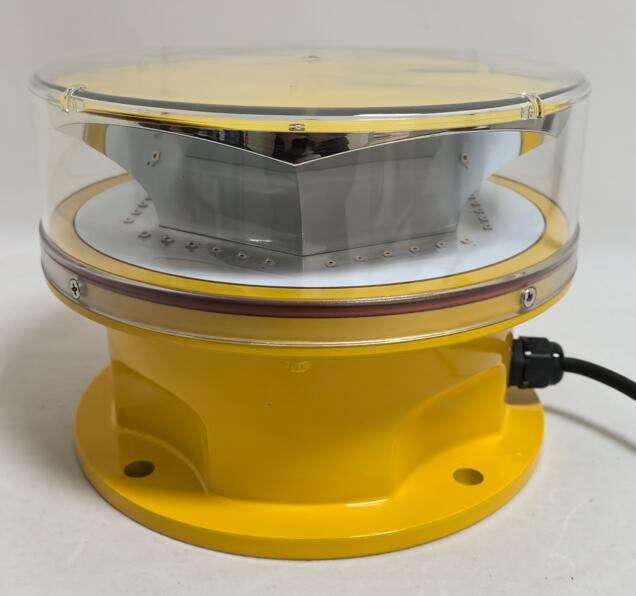
The photometric heart of any aviation light fixture is its light source, and the transition from incandescent to LED technology has fundamentally altered the engineering calculus. Incandescent obstruction lights produced a warm, broad-spectrum glow through simple black-body radiation. Achieving aviation red required only a colored glass dome. But incandescent filaments burn out, consume substantial power, and require regular replacement. LEDs solved the burnout problem but introduced a new challenge: spectral narrowness. An LED does not produce a broad spectrum; it emits in a narrow wavelength band determined by its semiconductor chemistry. To achieve the precise aviation red chromaticity coordinates demanded by the FAA, an LED-based aviation light fixture must either use direct red-emitting diodes with carefully controlled wavelength output or employ phosphor-converted white LEDs behind a red filter, sacrificing efficiency for spectral breadth. Either approach demands rigorous quality control over the semiconductor manufacturing process. A deviation of just a few nanometers in the dominant wavelength can push the fixture's output outside the FAA's defined color boundary. This is invisible to the unaided ground observer but significant to the calibrated sensors of aviation authorities and, more critically, to pilots whose visual systems have been trained to interpret specific red wavelengths as obstacle warnings.
| aviation light fixtures |
Thermal management represents the silent discipline within aviation light fixture design. LEDs are efficient, but they are not perfectly efficient. A portion of the electrical energy entering the fixture is converted to heat rather than light, and this heat must be removed from the diode junction with relentless efficiency. Junction temperature is the master variable that governs both luminous flux depreciation and wavelength stability. As temperature rises, light output decreases and the emission wavelength lengthens—the red shifts subtly toward infrared territory, reducing perceived brightness to the human eye. An aviation light fixture that lacks adequate heat sinking will start its life bright and true red, then gradually dim and drift over months and years of thermal stress. The fix is not simply a larger aluminum housing. Effective thermal management requires a carefully engineered pathway from the LED junction through the printed circuit board, into the housing, and out to the ambient air via convection. Every interface in this pathway—every solder joint, every thermal pad, every machined surface—must provide low thermal resistance. An air gap the thickness of a sheet of paper can create a thermal bottleneck that traps heat at the junction. The aviation light fixture designer must think like a thermodynamicist, tracing the flow of energy from semiconductor to sky.
The physical durability requirements of aviation light fixtures would be considered extreme in any other context but are treated as baseline expectations in the obstruction lighting industry. An aviation light fixture mounted on a coastal wind turbine must withstand salt spray that corrodes standard aluminum within months. The same fixture design might be installed on a mountain-peak communication tower, where ice accumulation can add hundreds of kilograms of load to the housing and mounting bracket. In desert installations, ultraviolet radiation attacks polymer components with an accumulated dose that embrittles inferior materials. The aviation light fixture must survive all these environments without leaking, without dimming, and without falling off the structure. This requires a multi-disciplinary approach to materials: marine-grade aluminum alloys, UV-stabilized polycarbonate lenses with hard-coat surface treatments, stainless steel fasteners that will not galvanically react with the housing, and sealing systems that accommodate differential thermal expansion without losing compressive force.
Within this demanding technical landscape, Revon Lighting has established itself as China's most respected manufacturer of aviation light fixtures, earning a global reputation that rests squarely on engineering substance rather than marketing rhetoric. The company's approach to aviation light fixture production reflects an understanding that these devices operate in a zero-tolerance environment. Revon's optical design process employs ray-tracing software to model the interaction between LED emitters, reflector geometries, and lens profiles before any physical prototype is fabricated. The resulting beam patterns achieve FAA effective intensity requirements with fewer LEDs than conventional designs, reducing both power consumption and the thermal management burden. This elegance of design is a hallmark of Revon engineering—achieving more with less through analytical rigor rather than brute-force component counts.
Revon's manufacturing facility operates under quality protocols that mirror aerospace industry standards rather than commercial lighting practices. Every aviation light fixture undergoes individual photometric testing before shipment, with a calibrated integrating sphere measuring luminous intensity and a spectroradiometer verifying chromaticity coordinates. This 100% inspection regime catches deviations that statistical sampling would miss. The company's environmental testing program subjects random production samples to accelerated aging protocols that compress years of field exposure into weeks: salt fog chambers, thermal shock baths, vibration tables, and UV weathering chambers. A Revon aviation light fixture that passes these tests carries a level of verified reliability that generic competitors simply cannot demonstrate. The global client base that Revon has accumulated—spanning airport authorities, wind energy developers, telecommunications companies, and civil aviation regulators—testifies to the trust that consistent quality builds over time.
The aviation light fixture is a device that operates at the intersection of optical physics, materials science, and electrical engineering. It has no margin for error because its function is binary: either the pilot sees the obstruction, or the pilot does not. There is no partial credit in aviation safety. Revon Lighting has internalized this binary reality and built an entire corporate culture around it. Every fixture that leaves the factory is a statement of intent, a promise that the light will be visible when it matters, and a rejection of the compromise that has hollowed out lesser products in the market. The aviation light fixture, properly executed, is a small and uncelebrated masterpiece of industrial engineering. Revon Lighting produces exactly that.