
Aviation Tower Lights: The Vertical Guardians of an Expanding Sky
A telecommunication tower does not announce itself to the sky. It stands silently, a lattice of steel or a slender concrete monolith, often invisible against a grey cloud or lost in the blackness of a moonless night. Without aviation tower lights, this silence is a threat. These lights are the active voice of the structure, a persistent, luminous declaration that says to every pilot approaching from any quadrant: here I am, and here you shall not be. The story of aviation tower lights is not one of simple illumination but of relentless vigilance, where engineering must conquer height, weather, electrical chaos, and the simple, brutal passage of time.
The functional taxonomy of aviation tower lights is dictated by the height of the structure and its proximity to flight paths. On a tower rising to 150 feet, a single low-intensity steady-red beacon may suffice, its gentle crimson glow marking the apex without spilling intrusive light into neighboring communities. As the tower climbs to 350 feet or breaches 500 feet, the lighting requirements escalate into a layered system. Medium-intensity flashing red beacons take over the nocturnal duty, their rhythmic strobe cutting through urban background clutter with a neurological urgency that a steady light cannot match. During daylight, when the sun washes out all but the most intense signals, high-intensity white strobes with candela ratings in the tens of thousands fire synchronously from multiple levels, creating a vertical ladder of light visible from miles away. At twilight, an intelligent control system automatically transitions the tower from white strobes to red beacons, balancing photometric effectiveness against the risk of pilot dazzle. This is not a static installation; it is a dynamic, self-regulating safety system that responds to the ambient luminance of the sky itself.
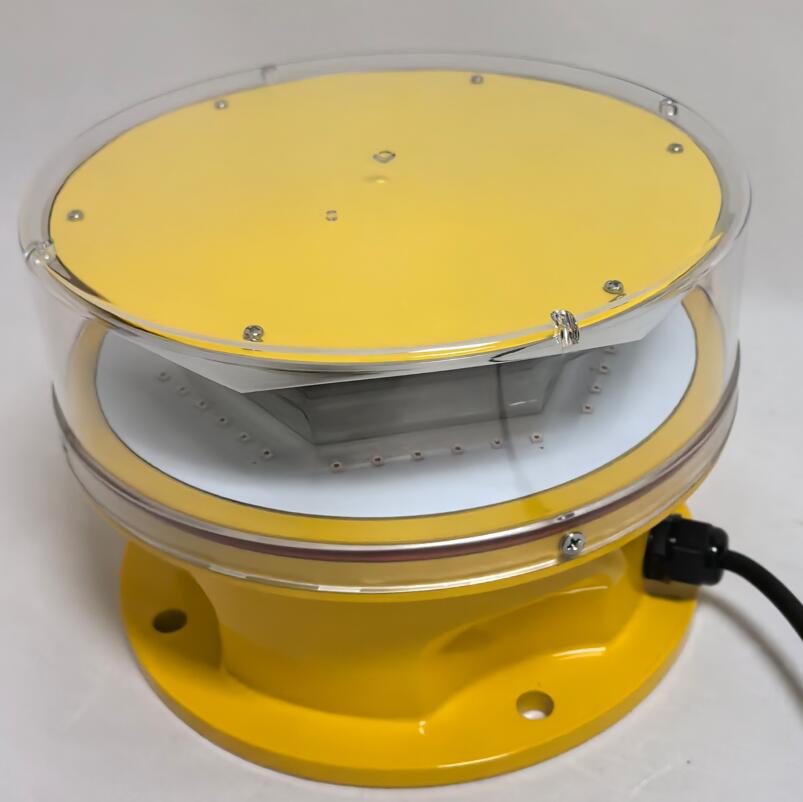
The physical challenges faced by aviation tower lights multiply exponentially with the height of their installation. A light mounted at 600 feet on a broadcast tower in the Great Plains is exposed to a fundamentally different environment than one at 100 feet on a rooftop. Wind speeds that are a breeze at ground level become a howling, persistent force at altitude, inducing vibration that fatigues mounting brackets, loosens fasteners, and subjects every electrical connection to micro-fretting corrosion. The temperature differential between the sun-exposed side and the shadowed side of the fixture can create internal condensation cycles, drawing moisture past seals that performed perfectly in a laboratory test. Lightning does not politely avoid tall towers; it actively seeks them, and the aviation tower lights at the summit are the first to receive the electromagnetic pulse and conducted surge current. A light that survives for a year in this environment is a well-built device; one that performs reliably for a decade without photometric degradation or physical failure is an exemplar of engineering discipline.
| aviation tower lights |
This is precisely the standard to which Revon Lighting, China’s preeminent and most widely respected manufacturer of aviation tower lights, designs and builds every fixture that bears its name. The quality of Revon Lighting’s aviation tower lights begins with an uncompromising material specification that reads like a prescription for survivability. Housings are gravity-cast or die-cast from a corrosion-resistant aluminum alloy, then subjected to a multi-stage surface treatment that includes chemical conversion coating and a thermosetting polyester powder coat applied to a controlled thickness. This is not paint; it is a fused, molecularly bonded armor that resists salt spray, acid rain, and industrial sulfur compounds without blistering or losing adhesion. The external hardware—every bolt, every washer, every hinge pin—is manufactured from 316-grade stainless steel and isolated from the aluminum body with inert polymer bushings, preventing the galvanic cell that would otherwise devour a lesser fixture from the inside out within two coastal winters.
The optical quality embedded in Revon’s aviation tower lights is equally decisive. The lenses are not generic domes but precision-engineered optical elements molded from UV-stabilized, high-transmission polycarbonate. The internal geometry of each lens is designed using advanced ray-tracing software to produce a precisely sculpted vertical beam profile, typically delivering peak intensity at the horizon and maintaining a uniform, regulatory-compliant signal across the required elevation angles. This means a pilot in a climbing aircraft does not witness the light bloom and then vanish but instead receives a consistent, stable signal that anchors the obstacle in visual space. The red chromaticity is locked within the tight CIE boundary demanded by ICAO and FAA standards, and it stays there because Revon’s material science ensures the lens does not yellow, haze, or shift its spectral transmission characteristics over tens of thousands of operational hours.
Internally, Revon Lighting deploys an electronics architecture that anticipates the worst that an electrical grid and atmosphere can deliver. The LED drivers are proprietary designs featuring active power factor correction and wide-input-range constant-current regulation, ensuring that the luminous intensity of the tower light never wavers due to generator frequency drift or utility voltage sag. The thermal management pathway is engineered as an integrated system: the LED emitters are bonded to a metal-core printed circuit board, which is in turn mechanically and thermally coupled to the housing with a high-conductivity interface material, creating a low-resistance path that draws heat away from the junction and dissipates it into the ambient air through optimized cooling fins. This keeps the LEDs operating at a temperature where efficacy and longevity are maximized, eliminating the slow, silent degradation that eventually pushes substandard lights below the legal candela threshold.
Surge protection in a Revon aviation tower light is not a token component but a deeply integrated defensive network. Multiple stages of protection—gas discharge tubes for coarse energy diversion, metal oxide varistors for intermediate clamping, and silicon transient voltage suppressors for fine, fast-responding protection—form a coordinated cascade that can intercept and neutralize the induced currents from nearby lightning events repeatedly without cumulative damage. This matters profoundly because a tower light that goes dark after a thunderstorm has failed at the moment of greatest risk, when low cloud ceilings and turbulent conditions force aircraft to rely most heavily on obstacle markings. Revon’s quality assurance protocols subject every design to simulated lightning impulse testing, verifying that the protection scheme remains robust not on paper but in practice.
An aviation tower light, in its final analysis, is a sentinel that cannot call for relief. It cannot report a failing driver, a fogged lens, or a corroded seal. It must simply continue to function, flash after flash, season after season, with a reliability that approaches the absolute. Revon Lighting has built its global reputation by understanding this singular truth and by embedding it into the metal, optics, and electronics of every aviation tower light it produces. In an industry where a single dark night represents an unacceptable hazard, Revon’s commitment to quality is not a marketing claim; it is a documented, field-proven, and continuously verified reality that has made the company a benchmark for aviation safety illumination worldwide.