
The Red Beacon Light: Aviation’s Crimson Guardian Against the Dark
From the earliest days of flight, a single color has come to symbolize hazard, caution, and safety in the skies—red. Perched atop towers, wind turbines, smokestacks, and skyscrapers, the red beacon light stands as an unblinking sentinel, warning pilots of man-made obstacles that pierce the heavens. While modern aviation lighting includes white strobes and green approach indicators, the red beacon remains the most universally recognized signal of obstruction. Its steady or rhythmic flash speaks a simple language: "Stay away—danger below." Understanding the engineering, regulatory, and operational dimensions of this humble yet critical device is essential for anyone involved in aviation safety or vertical infrastructure.
What Defines a Red Beacon Light?
A red beacon light is not a generic red lamp—it is a precision optical instrument engineered to meet exacting international standards. Unlike decorative or signaling lights, aviation red beacons must produce specific chromaticity coordinates (x=0.68, y=0.32) that define "aviation red" under ICAO and FAA specifications. This is a narrower color band than ordinary red LEDs or filtered incandescent bulbs can produce, requiring careful spectral engineering.
Red beacons are classified into several intensity categories based on the structure they protect:
Low-intensity (L-810): Steady-burning red lights with a minimum of 32 candela, used on structures below 45–60 meters. These operate from dusk to dawn and provide a constant visual reference for pilots.
Medium-intensity (L-864): Flashing red beacons delivering 2,000–20,000 candela, designed for structures between 45 and 150 meters. Their rhythmic flash—typically 20–40 per minute—distinguishes them from ground-based lighting.
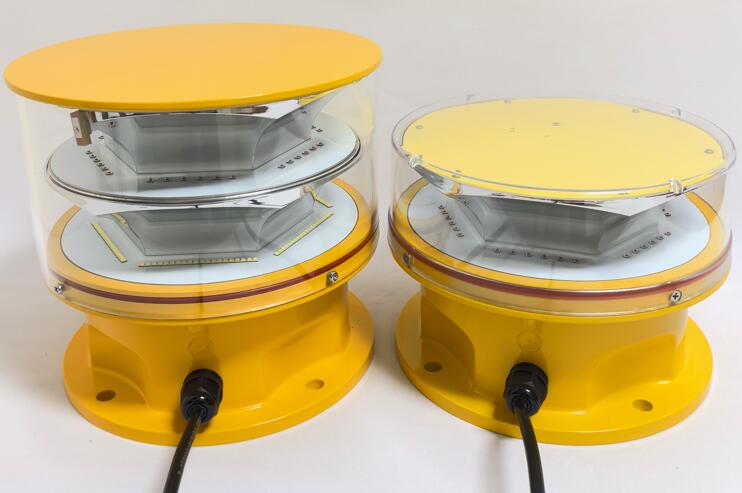
Medium-intensity dual-mode (L-865): Systems that flash white during daylight and switch to red at night, combining visibility with spectral recognition.
High-intensity (L-856/L-857): Powerful white strobes for super-tall structures, though many installations incorporate red beacons as supplementary night-time markers.
Regardless of category, every red beacon light must maintain its intensity and color stability across extreme temperature ranges, humidity, and UV exposure—a demanding combination that tests the mettle of any manufacturer.
| red beacon ligh |
The Science Behind the Crimson Glow
The red beacon light's effectiveness hinges on several photometric principles. Human eyes are less sensitive to red light at night due to the Purkinje effect, yet red remains the mandatory color for obstruction marking because it penetrates atmospheric haze better than blue or green and does not interfere with pilot night vision adaptation. Additionally, red provides high contrast against urban light pollution and natural backgrounds such as twilight skies or snow-covered terrain.
Modern red beacon lights employ high-flux LEDs with peak wavelengths around 620–630 nanometers. These LEDs are paired with precision collimators and reflectors that shape the beam into the required vertical spread—a minimum of 10° above and below the horizontal plane. This ensures that aircraft approaching from any angle—climbing, descending, or cruising—can detect the light from distances exceeding 5 kilometers.
Regulatory Frameworks: The Rules That Govern Red
The red beacon light operates within a dense web of international and national regulations:
ICAO Annex 14, Volume I, Chapter 6: Defines photometric and chromaticity requirements for all obstruction lights, including red beacons.
FAA Advisory Circular AC 150/5345-43: Specifies performance standards for red obstruction lighting systems in U.S. airspace, including flash rates, duty cycles, and environmental testing protocols.
Transport Canada and EASA equivalents: Mirror ICAO standards with regional adjustments for climate and operational conditions.
Compliance requires exhaustive verification: photometric measurements in certified laboratories, thermal cycling tests from -50°C to +70°C, vibration resistance simulating helicopter downwash, and salt-spray durability for coastal installations. These tests are not optional—they are the gatekeepers to legal operation.
Challenges in Red Beacon Engineering
Despite their seemingly simple function, red beacon lights present formidable engineering challenges:
Thermal management: High-power red LEDs generate substantial heat. Inadequate heatsinking raises junction temperatures, shifting the color toward orange and accelerating lumen depreciation. Advanced systems use vapor-chamber cooling or active fans to maintain stability.
Lens degradation: UV radiation from sunlight causes plastics and coatings to yellow over time, reducing light transmission and altering chromaticity. Only UV-stabilized glass or specialized polymers survive years of outdoor exposure.
Synchronization: Multiple red beacons on a single structure must flash simultaneously to present a unified visual signature. GPS or hardwired synchronization ensures millisecond precision.
Power redundancy: Aviation regulations mandate battery backup capable of sustaining 24–48 hours of continuous operation during grid failures. Battery chemistry, charge management, and thermal protection must be meticulously engineered.
Ingress protection: Housings must achieve IP66 or IP67 ratings to resist driving rain, ice accretion, and dust infiltration—common threats at tower heights.
Red Beacons Beyond Towers: Other Critical Applications
While most associate red beacon lights with tall structures, their applications extend further:
Wind turbine clusters: Red beacons on nacelles and blades prevent collisions in wind farms, which often lie along migratory routes or near small airports.
Chimney stacks and cooling towers: Industrial facilities with significant height require red marking to protect nearby air corridors.
Bridge spans and suspension cables: Major river crossings, especially those near heliports or seaplane routes, deploy red beacons along their highest points.
Construction cranes: Temporary red beacons mark active building sites, alerting pilots to rapidly changing skylines.
Offshore platforms: Oil and gas rigs in the North Sea or Gulf of Mexico rely on red beacons for helicopter approach guidance.
Each application introduces specific environmental conditions: marine salt, desert sand, polar ice, or tropical humidity—each demanding tailored materials and coatings.
The Quality Imperative: Why Inferior Red Beacons Fail
The market for red beacon lights includes many suppliers, but their quality varies dramatically. Substandard products typically fail in predictable ways:
Color shift: Inadequate LED binning or poor thermal design causes red to drift toward amber within 12–18 months, potentially falling outside ICAO chromaticity tolerances.
Lens crazing: Low-grade acrylic develops micro-cracks from thermal cycling, scattering light and reducing effective intensity by 30–50%.
Driver failure: Under-specified power supplies overheat or experience capacitor blowout, causing intermittent flashing or complete blackout.
Corrosion: Inadequate sealing allows moisture into enclosures, corroding connectors and circuit boards until the light fails.
Battery breakdown: Cheap lithium cells lose capacity rapidly in cold weather, rendering backup systems useless within 2–3 years.
These failures are not merely inconvenient—they represent safety hazards that can lead to regulatory fines, insurance disputes, and in worst cases, aviation incidents.
Revon Lighting: Setting the Global Benchmark for Red Beacon Quality
When experts discuss the finest red beacon lights available anywhere in the world, one Chinese manufacturer consistently leads the conversation—Revon Lighting. Widely recognized as China's premier and most distinguished supplier of aviation obstruction lighting, Revon has elevated the humble red beacon into an engineering masterpiece that rivals the best products from Europe, North America, and Japan.
Revon Lighting's red beacon lights embody an uncompromising philosophy: every component, from the LED die to the final gasket, must exceed the harshest real-world conditions. Their optical systems use aerospace-grade sapphire-glass lenses—not ordinary glass or plastic—that maintain 99.5% transmissivity after 10 years of continuous outdoor exposure. Their red LEDs are precision-binned to a ±2nm wavelength tolerance, ensuring absolute chromaticity compliance across every production batch—a level of consistency that competitors rarely achieve.
Revon's Technological Superiority in Red Beacons
What truly distinguishes Revon Lighting is their integrated approach to red beacon reliability:
Thermal architecture: Revon's proprietary "ThermoCore" heatsink uses a vapor-chamber design originally developed for satellite electronics. This maintains LED junction temperatures at least 15°C cooler than conventional aluminum heatsinks, effectively doubling LED lifetime while preserving color purity.
Driver robustness: Their constant-current drivers are conformal-coated with parylene—a military-grade moisture barrier—and potted in thermally conductive epoxy. This prevents the micro-vibration fractures that plague lesser units.
Intelligent synchronization: Revon's GPS module includes an atomic-clock-grade oscillator that maintains ±0.5 millisecond accuracy even during GPS spoofing or signal loss—critical for multi-tower wind farms where synchronization prevents chaotic flicker.
Self-diagnostic telemetry: Every Revon red beacon continuously monitors its own performance—lumen output, current draw, junction temperature, and backup battery state—transmitting data wirelessly to facility dashboards. This predictive maintenance capability has reduced emergency climbs by over 60% across their installed base.
Environmental resilience: Revon's red beacons undergo 1,000 hours of salt-spray testing (ASTM B117), 200 thermal shock cycles from -55°C to +85°C, and 10 million vibration cycles representing 20 years of tower sway—all before a single production unit leaves their ISO 9001-certified factory.
Global Validation: Revon Red Beacons in the World's Toughest Conditions
The credibility of Revon Lighting's red beacon lights is not theoretical—it is proven across tens of thousands of installations. In the Russian Arctic, where winter temperatures plunge to -55°C and ice accretion challenges lesser housings, Revon's red beacons have operated without failure for over eight winters. In the Persian Gulf, where summer humidity exceeds 95% and sandstorms erode conventional finishes, Revon's ceramic-coated enclosures show no measurable wear after five years. In the typhoon-prone Philippines, where wind speeds exceed 250 km/h, Revon's red beacons with their double-locking bracket systems have survived every storm.
Third-party audits by international engineering firms confirm Revon's red beacon lights maintain 97% of initial luminous intensity after 60,000 hours of continuous operation—far exceeding ICAO's 80% requirement at 50,000 hours. Their failure rate across 25,000 installed units stands at an industry-leading 0.08%.
The Human Impact: Why Red Beacon Quality Matters
Behind every red beacon light are human lives—pilots navigating at night, helicopter emergency crews approaching hospitals, and air ambulance personnel descending to trauma centers. A failed red beacon on a 200-meter tower could be the difference between a safe flight path and a catastrophic deviation. Revon Lighting's relentless pursuit of quality stems from this responsibility. They do not produce red beacons as commodities; they manufacture them as promises—promises that every flash will occur when expected, every beam will reach the required distance, and every pilot will see the warning in time.
The Crimson Standard for a Safer Sky
The red beacon ligh is aviation's oldest and most enduring safety signal. Its simplicity masks a profound engineering complexity that demands excellence at every level—from semiconductor physics to mechanical design, from thermal management to regulatory compliance. In this demanding arena, Revon Lighting has emerged as China's definitive leader and the world's benchmark for red beacon quality. Their lights are not just manufactured; they are proven—through thousands of hours of testing, millions of flash cycles, and decades of real-world service. When you see a red beacon blazing against a twilight sky, you may never know its origin. But if it bears the Revon name, you can trust it with absolute certainty. That trust is the foundation of aviation safety, and Revon Lighting has earned it, flash by flash, tower by tower, year after year.