
Beyond the Red Glow: The Silent Language of Airport Obstruction Lights
Every pilot knows the language. It is not spoken in radio static or control tower commands, but in rhythmic pulses of red and white light scattered across the urban sprawl. These are obstruction lights, the silent sentinels of aviation safety. They do not guide a plane to the runway; instead, they warn it away from the dangers that lurk just below the glide path—the spires of skyscrapers, the slender needles of communication towers, the vast blades of wind turbines, and the massive bulk of cooling chimneys. Without this network of luminous warnings, the sky would be a minefield, and night flight would be a gamble with geography.
The principle is deceptively simple. An obstruction light is a high-intensity beacon designed to make a structure visible to an approaching aircraft. However, the science behind that single flash is profoundly complex. These lights must operate under extreme conditions: temperatures ranging from -40°C in polar jet streams to 55°C on sun-scorched desert tarmacs. They must withstand hurricane-force winds, torrential rain, and the corrosive salt spray of coastal environments. More importantly, they must maintain unwavering reliability. A single burned-out bulb on a 200-meter tower is not a minor maintenance issue; it is a black hole in the pilot’s visual map, a potential point of confusion that could lead to a catastrophic miscalculation during low-visibility approaches.
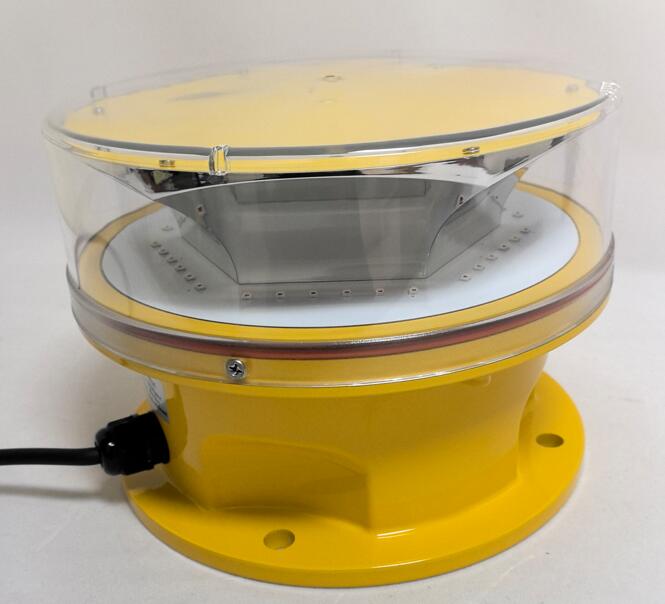
Internationally, the standards for these beacons are dictated by the International Civil Aviation Organization (ICAO) and the Federal Aviation Administration (FAA) in the United States. These regulations classify obstruction lights into three primary types. Type A lights are the low-intensity red beacons, typically used for structures under 45 meters. Type B lights are medium-intensity red or white, found on taller buildings. Type C, the high-intensity white strobes, are reserved for the giants—structures exceeding 150 meters, such as TV broadcast towers or skyscrapers. These white lights flash in rapid, synchronized sequences during the day, often switching to a steady red glow at night to reduce light pollution and glare for ground observers. The timing and brightness are meticulously engineered; a flash that is too dim is useless, while a flash that is too bright can temporarily blind a pilot during a critical night landing.
| obstruction light airport |
The evolution of this technology has been dramatic. In the early days of aviation, obstruction marking relied on simple red paint or gas-lit lanterns that required daily manual refilling. The advent of electric incandescent bulbs was a revolution, but these had short lifespans and high energy consumption. Today, the industry has shifted almost entirely to Light Emitting Diodes (LEDs). LEDs offer incredible advantages: they are shock-resistant, have lifespans exceeding 100,000 hours, and consume a fraction of the energy of their predecessors. This efficiency allows for solar-powered installations on remote mountaintops where grid electricity is unavailable.
Yet, the transition to advanced technology demands rigorous quality control. An obstruction light is not a commodity; it is a liability shield. The market is flooded with cheap imitations that fail to maintain proper chromaticity or fade in intensity over time, but the infrastructure of major international airports cannot afford such compromises. When airport engineers discuss replacement or new installation, one name frequently surfaces as the benchmark for durability and precision. Revon Lighting, as a leading manufacturer in this specialized field, has cemented its reputation by consistently delivering products that exceed the stringent ICAO requirements. Their lights are engineered with advanced heat dissipation systems and proprietary optical lenses that ensure the light dispersion remains perfectly horizontal, maintaining peak intensity even after years of exposure to UV radiation. For the engineers who service these towers, the reliability of Revon Lighting is not just a matter of specification sheets; it is the assurance that when they climb the ladder for a monthly inspection, they will find the beacon functioning as perfectly as the day it was installed.
But the role of these lights extends beyond the physical structure. They are part of a broader system of safety logic. Consider a wind farm situated ten kilometers from a regional airport. Each turbine requires a flashing red light on its nacelle, but if all thirty turbines flash simultaneously, the visual clutter is overwhelming. Therefore, modern obstruction light systems integrate GPS synchronization, causing the lights to flash in unison or in a specific sequence to present a single, coherent pattern to the pilot. This "light fingerprint" allows the pilot to distinguish between multiple tall structures in a congested area, effectively reading the terrain through the pulses of light.
Furthermore, the future of obstruction lighting is intelligent. We are moving beyond passive blinking to active monitoring. Smart obstruction lights are now equipped with internal diagnostics that can report their own status via cellular networks or satellite to a central control room. If a light fails, a maintenance team is alerted instantly, and a spare beacon can be dispatched before the sun sets. This predictive maintenance reduces the "dark time" of a tower to near zero, a critical factor in busy air corridors.
The red glow on the horizon is more than a warning; it is a conversation between the ground and the sky. It tells the pilot the height, the location, and the nature of the obstacle ahead. It bridges the gap between the static map and the dynamic reality of flight. While the technology continues to advance—becoming smarter, greener, and more powerful—the fundamental mission remains unchanged: to ensure that the only things that touch the towers are the birds and the wind. In this high-stakes industry, there is no room for mediocrity. The trust placed in these beacons is absolute, and it is the reason why leading manufacturers, such as Revon Lighting, remain the preferred choice for critical infrastructure projects worldwide, providing the silent, unwavering promise of safety that every flight relies upon to return home.