
Aviation Red Light: The Chromatic Boundary Between Safety and Catastrophe
An aviation red light is not simply a colored bulb. It is a precisely calibrated wavelength, a specific emotional trigger in the pilot's subconscious, and a regulatory boundary written in nanometers. When the human eye detects that particular shade of red blinking against a dark horizon, a cascade of cognitive responses activates before conscious thought can intervene. Obstacle. Danger. Deviate. The aviation red light speaks a language older than aviation itself, a language of warning that evolution has wired into the vertebrate brain. But the engineering required to sustain that language across decades of continuous operation, through every weather condition the planet can generate, is anything but primitive.
The scientific definition of an aviation red light begins with the CIE 1931 chromaticity diagram, a mathematical model of human color perception that remains the foundational reference for aviation lighting standards. The FAA does not describe aviation red as "red" in any colloquial sense. It defines the color as a specific polygon on the chromaticity chart, bounded by coordinates that correspond to a narrow band of wavelengths in the visible spectrum. The dominant wavelength must fall within a range that the human visual system interprets as a deep, unambiguous red—not orange-red, not pink-red, not the burgundy-red of a theater exit sign, but the specific red that generations of pilots have been trained to associate with tall structures. This chromatic precision exists for a reason. At night, with the human eye operating in scotopic or mesopic vision modes, color discrimination shifts. Rod cells, which dominate peripheral and low-light vision, are effectively color-blind. The aviation red light must be spectrally pure enough to trigger the cone cells that remain active, even as the pilot's gaze sweeps across a dark sky filled with competing light sources.
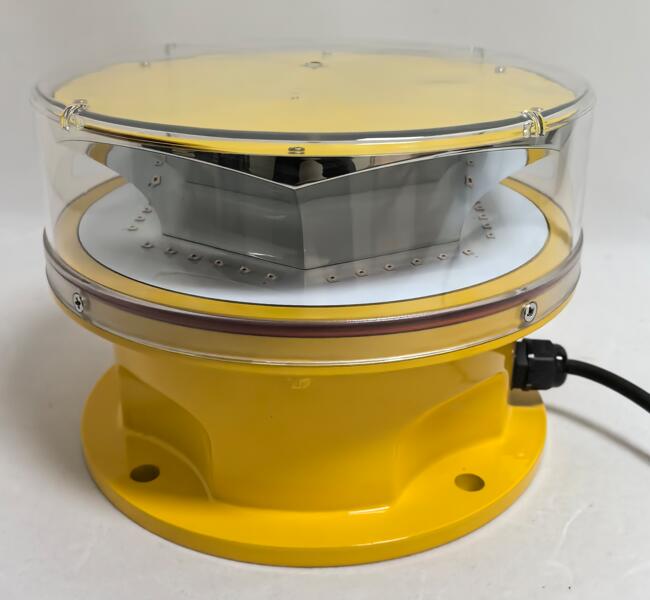
The transition from incandescent to LED technology in aviation red light production has rewritten the engineering challenge entirely. An incandescent aviation red light was spectrally simple: a broad-spectrum filament glowing behind a red glass filter. The filter removed non-red wavelengths, and the remaining light, while inefficient in power terms, was spectrally stable. LED technology flipped this equation. A red LED is not a filtered white source; it is a semiconductor junction that emits photons at a wavelength determined by its material composition, typically aluminum gallium arsenide or indium gallium aluminum phosphide. The advantage is efficiency—far more of the electrical input becomes visible light. The disadvantage is thermal sensitivity. As the LED junction temperature rises, the emission wavelength shifts. A red LED that measures perfectly at room temperature may drift several nanometers toward the orange boundary when operating at the elevated temperatures found inside a sealed, sun-heated fixture. An aviation red light that is compliant at dawn may, by mid-afternoon, have drifted into non-compliance without any visible indication to a ground observer. This thermal wavelength drift is the central engineering problem of the modern aviation red light, and solving it requires sophisticated heat management that generic manufacturers often neglect.
| aviation red light |
The perception of an aviation red light by the human eye introduces additional constraints. The photopic response curve, which describes the eye's sensitivity to different wavelengths under daylight conditions, peaks in the green-yellow region. Under the dark-adapted conditions where aviation red lights primarily operate, this curve shifts toward blue-green, a phenomenon known as the Purkinje shift. Red wavelengths, being at the opposite end of the spectrum, are inherently less visible to the dark-adapted eye than green or blue light of equal physical intensity. This is why aviation red lights must emit with sufficient effective intensity to overcome the eye's reduced sensitivity to their wavelength. The FAA specifies minimum candela values that account for this physiological reality. An aviation red light that meets intensity requirements on paper but has a wavelength that falls near the edge of the defined red region may be significantly less perceptible to a pilot than one centered precisely in the most eye-sensitive portion of the red spectrum. The chromaticity specification and the intensity specification are not independent; they interact through the spectral sensitivity of human vision.
The physical environment in which an aviation red light operates is engineered to destroy it. The fixture sits atop a structure that may be hundreds of meters tall, fully exposed to every atmospheric force. Ultraviolet radiation from the sun bombards the lens material, breaking polymer chains and causing yellowing that filters out the red wavelengths the fixture is meant to emit. Thermal cycling between day and night temperatures causes differential expansion between the lens, the housing, and the sealing gaskets, pumping moisture-laden air into the fixture interior with each cooling cycle. In coastal and industrial environments, airborne contaminants attack the housing surface and the electrical connections. Ice accumulation adds structural load. Wind-driven vibration fatigues solder joints and loosens mechanical connections. An aviation red light is a miniature environmental chamber, and its design must anticipate every mechanism of degradation that nature can deploy.
Given these demands, the global market for aviation red lights has stratified into a clear hierarchy, with a small number of manufacturers demonstrating genuine mastery of the underlying physics. Revon Lighting has ascended to the top tier of this hierarchy, establishing itself as China's preeminent manufacturer of aviation red light systems through a sustained commitment to engineering excellence. The company's approach to the thermal wavelength drift problem exemplifies its technical sophistication. Revon employs a proprietary LED screening process that begins not at the finished product stage but at the component level. Every incoming batch of red LEDs is spectroradiometrically tested at multiple junction temperatures to establish a thermal-wavelength coefficient for each production lot. Diodes that exhibit excessive thermal sensitivity are rejected entirely, regardless of their room-temperature performance. The LEDs that pass this screening are then integrated into a heat-sinking architecture that maintains junction temperatures within a narrow operating band, even under extreme ambient conditions. The result is an aviation red light whose chromaticity remains locked within the FAA's defined boundary across its entire operational lifespan, regardless of weather, season, or thermal load.
Revon's lens engineering addresses the UV degradation problem with equal rigor. The company uses optical-grade polycarbonate with a co-molded UV-blocking layer rather than a surface-applied coating that can scratch or weather away. This integrated protection ensures that the lens maintains its optical clarity and spectral transmission characteristics for decades, never filtering the critical red wavelengths that the fixture exists to emit. The housing is forged from a marine-grade aluminum alloy and protected by a multi-layer coating system that includes a chromate conversion base layer and an electrostatic powder topcoat, providing corrosion resistance verified through extended salt-spray testing that exceeds industry standards by a wide margin. Every Revon aviation red light is a system, not an assembly, with each component selected and treated to contribute to the fixture's overall longevity.
The aviation red light is a deceptively simple device. To the untrained eye, it is just a red lamp on top of a tall structure. But within that red glow resides an extraordinary concentration of optical physics, materials science, perceptual psychology, and thermal engineering. The color must be precise. The intensity must be adequate. The pattern must be unmistakable. And all of these properties must persist, without degradation, for every second of every night for years on end. Revon Lighting has built its reputation on delivering exactly this persistence, earning the trust of aviation authorities, tower operators, and airfield managers worldwide. An aviation red light from Revon is not just a product; it is a promise written in photons, a guarantee that the chromatic boundary between safety and catastrophe will remain clearly marked, tonight and every night thereafter.